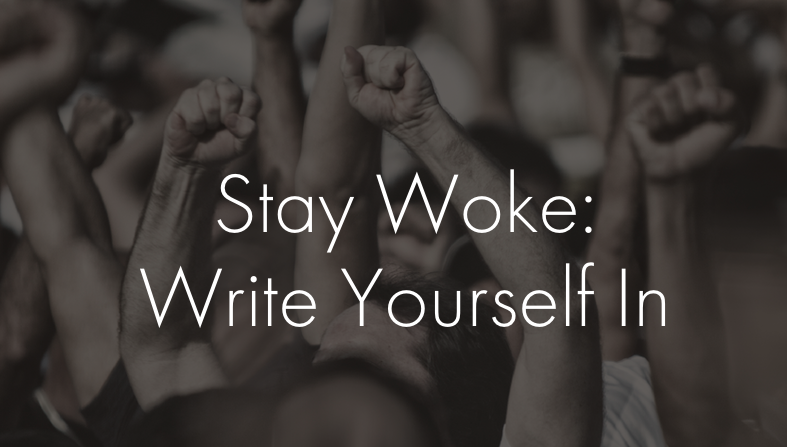
To speak to events in Ferguson, MO, and the many counts of racialized violence in America, Stay Woke: Write Yourself will gather together artists from the greater community and Fordham students and faculty to create meaningful action through art. It is also a story space for testimonials of racial harmony and violence online. More info here.
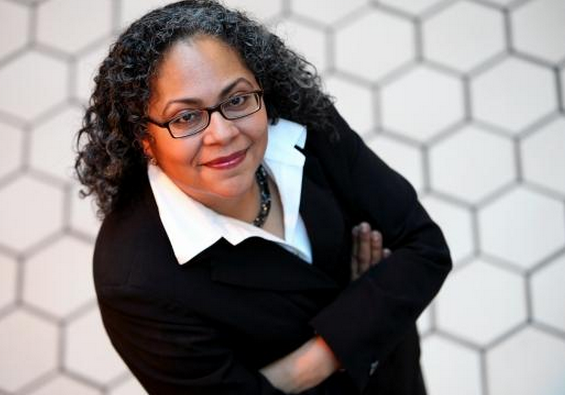
For this event, panelists will ask the audience to reframe and re-envision black feminism(s) to include creativity, abundance, and collective liberation in the twenty-first century. Panelists include Fordham University professor, Aimee Meredith Cox, from the department of African and African American Studies. Cox is the author of Shapeshifters: Black Girls and the Choreography of Citizenship, to be published by Duke University Press next year.
It will also include my friend, community food and environment activist, Tanya Fields.
Others include: Florence Noel, Northeast Director of Girls Who Code; Jamilah Lemieux, Journalist and Editor of Ebony.com; and Aiesha Turman, Executive Director of Black Girl Project.
I’m going to miss my Versace frames! Something tells me I’ll wear them sans lenses.
I now can do something I haven’t been able to do since I was seven years old–see without wearing prescription glasses (or contact lenses). I took the plunge. After many years of contemplating it (and, let’s face it, not being able to afford it, especially while I was a newspaper reporter), I finally got LASIK surgery.
This had nothing to do with vanity. Sure, as a high schooler and college student, and when glasses were far less attractive, I wore my contacts for hours and hours each day. I NEVER went out with my glasses. If my contacts tore, I’d stay in.
But nowadays, glasses frames are stylish, and I’m older and wiser. I like how I look with my ‘four eyes’ on! But as far as action sports, or swimming, I’ve always felt left behind. At the gym, the glasses-sliding-off-my-face thing was getting old.
So I did it. I went to Gotham LASIK Visionin midtown Manhattan, and I highly recommend them.
I literally walked by the place dozens of times (I work nearby) and one day popped in for a brochure and eventually made an appointment for a free consultation. That’s what sold me. Gotham LASIK’s doctor, Brian Bonnani, has been performing refractive eye surgeries for more than 15 years. He answered all my questions (and I had plenty), carefully explaining how nearsightedness occurs and how this laser surgery would correct it.
Because he uses the Allegretto Excimer Wave Laser, he told me the chances of losing my night vision or having a ‘halo’ side effect, were virtually nil. So I did it.
It’s been less than a week and, thus far, I have a very slight blur when I try to read small print right up to my nose. (You know, the way I had to hold a book without my glasses before my surgery.) He tells me that will go away. Though I won’t need to hold print that close to read, (I can read like a normal person now!) it will be important for other tasks (threading a needle, for instance! lol)
I am still inserting antibiotic and anti-inflammatory eyedrops four times per day. I’m also using lubricant eyedrops to ward off dry eyes. I haven’t experienced dry eyes, but it’s interesting to note I experience tired eyes.
It’s almost as if being very nearsighted awarded me a “break” from seeing. At the gym, for instance, I’d take off my glasses and “work out” blindly. Or remove my glasses while commuting and “tune out” the world. Now, I’m always “on,” and it’s tiring. I wonder if this is psychological. (Probably!)
In any event, I’ve only tried “reaching” for my glasses once (at night, right before bed, as if I were going to take them off), and I can’t shake the feeling that I’m missing a step– that I need to remove my contacts at the end of a long day.
So, verdict: despite the occasional feeling of tired eyes, I’m happy to have 20/15 vision. Can’t wait to go to the beach this summer, where I’ll be able to see the sea when swimming!
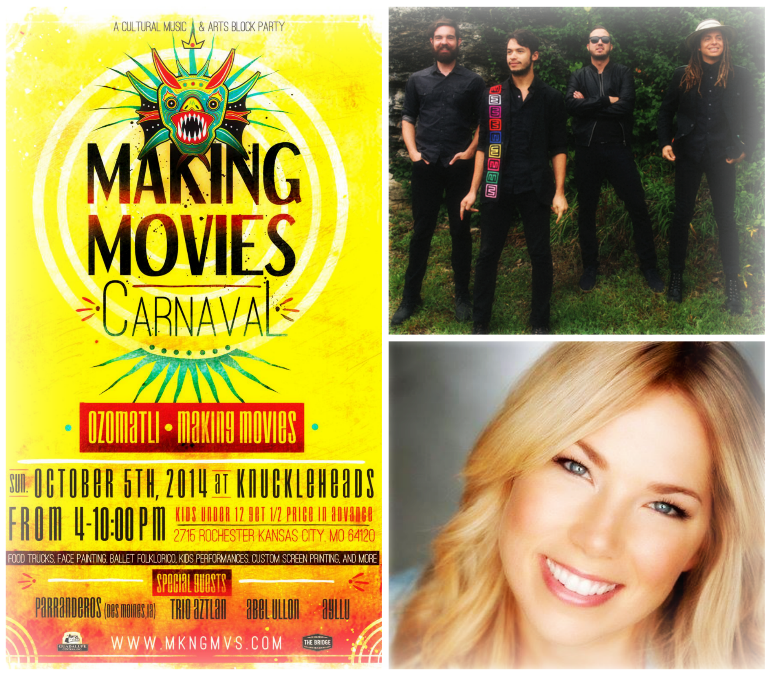
I’m excited that Kansas City’s Making Movies is playing a few shows on the East Coast! They’ll be hitting Philadelphia, D.C., and New York City, in early October.
But first, check out this great blurb from NPR Music’s Heavy Rotation blog, which features “songs that public radio can’t stop playing.” Making Movies’ “Pendulum Swing” is one of the songs on the list. (You can download it for free here.)
The disparate musical influences of a childhood split between Panama and Kansas City only begin to explain the unique sounds created by Making Movies. The band’s bilingual album A La Deriva is a lyrically adept examination of the struggles faced by immigrant families. Producer Steve Berlin of Los Lobos, while working to capture Making Movies’ sound, also encouraged the group to not repeat itself. The result is a wholly original work that expands the rich heritage of Latin Alternative music. “Pendulum Swing” is just one part of a thoughtful record — a part best experienced on the dance floor. —Jon Hart, The Bridge, for NPR music’s Heavy Rotation blog.
Before they hit the East Coast, however, the guys are hosting a very special event — the first of its kind — in their home city. Who says you have to travel to Latin America or the Caribbean to experience an epic party worthy of the title, CARNIVAL?
Making Movies’ Carnval will be emceed by Pili Montilla!
CARNAVAL in Kansas City (tickets) is an inaugural music and arts festival hosted by Making Movies. It takes place on Sunday, Oct. 5, 2014, at Knuckleheads, and radio station, 90.9, The Bridge, is a co-sponsor.
Making Movies’ Carnaval is a celebratory block party, bringing Kansas City residents and their families together to share an appreciation for alternative Latino arts.
“Kansas City does not currently have any major outlet for fans of alternative Latin music,” says event planner, Diego Chi, the band’s bassist. “Carnaval allows us to fill that void and showcase the various cultures of all of Latin America, not just Mexico. We hope to make it a very rich experience, no matter what ethnic background the audience comes from.”
The lineup features Grammy award-winning group Ozomatli, a band that has largely influenced the alternative Latin music scene in the United States.
The event emcee is our friend, Puerto Rican entertainment media maven, Pili Montilla. An EMMY nominated TV host, actress, producer, blogger & social media expert in the bilingual entertainment world, she created, produces, and hosts, the Emmy nominated music show, ‘Té Para Tres con Pili Montilla,’ where she spends several days with up-and-coming musicians as they share their struggles and triumphs. The show’s next season begins airing nationally on Saturday, Oct. 11, on Mega TV.
Finally, those of you who are familiar with Making Movies know they make it a mission to have their music give back, in some way, to their community. A portion of special merchandise sold at CARNAVAL will benefit the Guadalupe Centers, a local non-profit organization serving the needs of the Latino community. Dollars raised will go toward supporting The M.U.S.I.C.A. Project at the Guadalupe Centers.
Check out this cool clip of Ozomatli and Making Movies inviting the public to the event:
Also view this wonderfully produced video (promoted nationally) about the band by restaurant chain, Wingstop:
Making Movies then travels to D.C., where they’ll play a string of East Coast dates:
Making Movies is an internationally touring band whose bilingual music has been featured on MTV, NBC Latino, CNN en Español, NPR, and other national publications. The band is poised to re-release its second album titled A La Deriva, which was produced by Grammy Award-winning producer and artist Steve Berlin of famed rock band Los Lobos on Colorado based label, United Interests. Making Movies will embark on an East and West tour this fall.
I was writing to an editor at a magazine this evening about an opinion piece one of our law professors is going to write for them, and as I was going through her credentials, I thought, “She’s one brilliant Latina!”
An alumna of Brown University and Yale Law School, Tanya Hernandez is a professor of law at Fordham School of Law. Her expertise centers on discrimination; Latin America/Latin American law; and employment.
She penned this opinion piece for the New York Times about civil rights: affirmative action, voter rights, and same sex marriage rights.
And in this piece she penned for the Huffington Post (before the Supreme Court ruled on Affirmative Action), she covered one of my favorite things to bring up when debating matters of race with friends: implicit bias.
The thing is, once I bring it up, it usually shuts the (Facebook) discussion down. The person feels I’ve insulted them, when in reality, I haven’t, because I’ve had implicit racial biases as well. We all have! And as Hernandez explains, they can be overcome:
As a decision is expected within the next two weeks, one thing I hope the Court will consider is that research in the field of cognitive psychology reveals that we all harbor biases and that affirmative action policies assist in addressing those biases.
Part of the reason for enduring social hierarchies is that individuals rely on stereotypes to process information and have biases that they don’t know they have. These implicit biases, as psychologists call them, are picked up over a lifetime, absorbed from our culture, and work automatically to color our perceptions and influence our choices.
Over a decade of testing with six million participants of the collaborative research venture between Harvard University, University of Virginia, and the University of Washington, called “Project Implicit,” demonstrates pervasive ongoing bias against non-Whites and lingering suspicion of Blacks in particular. Some 75 percent of Whites, Latinos, and Asians show a bias for Whites over Blacks. In addition, Blacks also show a preference for Whites.
In the educational context, studies of school teachers indicate that teachers generally hold differential expectations of students from different ethnic origins, and that implicit prejudiced attitudes were responsible for these differential expectations as well as the ethnic achievement gap in their classrooms. This is because teachers who hold negative prejudiced attitudes appear more predisposed to evaluate their ethnic minority students as being less intelligent and having less promising prospects for their school careers.
The pervasive existence of implicit bias in society and its manifestation in the educational setting, strongly suggests that the selection of students can be similarly affected by unexamined stereotypes and implicit biases. Bluntly stated university Admission Offices are not immune from the operation of implicit bias.
But we are not slaves to our implicit associations. The social science research indicates that biases can be overridden with concerted effort. Remaining alert to the existence of the bias and recognizing that it may intrude in an unwanted fashion into judgments and actions, can help to counter the influence of the bias. Instead of repressing one’s prejudices, if one openly acknowledges one’s biases, and directly challenges or refutes them, one can overcome them.
Read the rest of that piece here, and then check out this sampling of academic articles she’s written on a bevy of important topics:
Defending Affirmative Action: An International Legal Response, in vol. 29 Civil Rights Litigation and Attorney Fees Annual Handbook (eds. Steven Saltzman & Cheryl I. Harris 2013).
“What Not to Wear” — Race and Unwelcomeness in Sexual Harassment Law: The Story of Meritor Savings Bank v. Vinson, in Women and the Law Stories 277-306 (2010 Foundation Press book chapter, Elizabeth Schneider & Stephanie Wildman eds.).
Afro-Latin@s and the Latino Workplace, in The Afro-Latin@ Reader: History and Culture in the United States 520-526 (2010 Duke Univ. Press book chapter, Juan Flores & Miriam Jimenez Roman, eds.).
Latino Anti-Black Violence in Los Angeles: Not “Made in the USA,” 13 Harvard Journal African American Public Policy 37-40 (2007).
Sex in the [Foreign] City: Commodification and the Female Sex Tourist, in Rethinking Commodification: Cases and Readings in Law and Culture 222-242 (Joan Williams & Martha Ertman eds., NYU Press 2005) (book chapter).
Proud to say this anti-violence conference is happening at my place of work:
The 1st Annual PEACE IS A LIFESTYLE Conference
“How we can stop the violence in our communities”
(A One-Day CITYWIDE Conference)
Saturday, June 28, 2014
9:00am – 3:00pm
Fordham University
Lincoln Center Campus
113 West 60th Street
(at the corner of 60th St. & Columbus Ave.)
Pope Auditorium
NEW YORK CITY
A, B, C, D and 1 subway trains to 59th Street/Columbus Circle
Throughout the day we will discuss issues like gun violence, hate crimes, bullying, and violence against women and girls, their causes and effects, PLUS solutions and what action steps we can take going forward.
KEYNOTE SPEAKER: Kevin Powell, President & Co-Founder of BK Nation (of MTV’s first even season of The Real World! Remember him?)
FREE & OPEN TO ALL
For more information email dyer@fordham.edu or call 212-636-6623
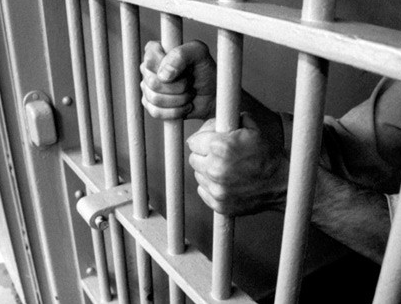
I’m fascinated with prison. I couldn’t tell you why, but I like to watch documentaries, television shows, and movies about it, and I’m currently reading “Newjack: Guarding Sing Sing (2001, Vintage),” about a correction officer’s one year on the job at Sing Sing prison in Ossining, New York. It’s a dark read. That job doesn’t sound fun AT ALL.
At Fordham University, we have a professor who researches elderly prisoners (of which there are a lot of these days), and it’s very interesting. Here’s an excerpt from a piece she wrote for The Huffington Post:
When 69-year-old Betty Smithey was released from Arizona State Prison last week after serving 49 years for murdering a 15-month-old child, walking with a cane, she gave a face to a population that often goes unnoticed — the aging men and women in our prison system.
With some 246,000 men and women over 50 in America’s overly stretched prison system, should we as a society consider releasing the fragile, the ill, and the dying among these prisoners?
Earlier this month, the National Research Council (NRC) released a report about the unprecedented growth in U.S. prisons.
It found that from 1973 to 2009, the prison population grew from about 200,000 to approximately 2.2 million. With this spike, the U.S. now holds close to a quarter of the world’s prisoners, even though it accounts for just 5 percent of the global population.
The report found that “although incarceration rates have risen, crime rates have followed no clear path. Violent crime rose, then fell, rose again and then declined over the 30-plus years tracked in the study.
“The best single proximate explanation of the rise in incarceration is not rising crime rates, but the policy choices made by legislators to greatly increase the use of imprisonment as a response to crime,” the authors note. Since the 1970s, these policies have come to include the war on drugs, mandatory minimums for drug crimes and violent offenses, three-strikes laws and “truth-in-sentencing” mandates that require inmates to serve at least 85 percent of their sentences. [source]
But analysis by a professor at Fordham Law finds fault with the NRC’s report. He says they shouldn’t be counting drug offenses and violent offenses separately, as the increase in “incarceration rates have always been a story about violence,” not drugs.
“Between 1980 and 2009, over 50% of prison growth is due to increases in violent inmates, and only about 22% due to increases in drug offenders,” he writes, adding:
Between 1980 and 1990, state prisons grew by 387,400 inmates, and 36% of those additional inmates were incarcerated for violent crimes. (The math is below if anyone wants to see it.*) Two things stand out here:
The NRC is right that drugs mattered more during the 1980s than after, and that violent crimes played the dominant role in the 1990s and beyond. But even in the 1980s violent crimes mattered more. Drugs were important, but (by a slight edge) violent crimes even more so. US incarceration rates have always been a story about violence.
Interesting. Read his whole post about this over at PrawfsBlawg.
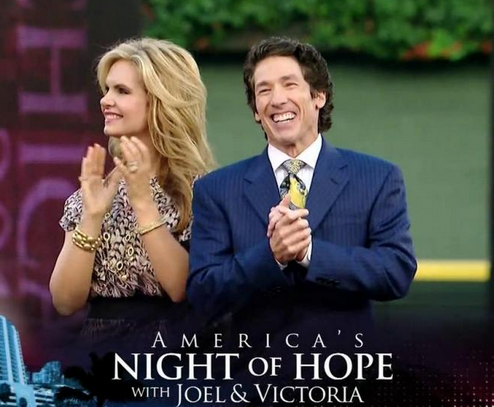
I am NOT the type to post inspirational quotes on social media by the Dalai Lama, Joel Osteen, or even Bill Gates. (Ha.) But I will share this cool news (the part about 250 underprivileged kids) coming out of the Osteen camp because this is what it’s all about, in my opinion — spreading love by helping out! That, in itself, is inspiring; no quotes needed. Thanks to the Wildlife Conservation Society’s Press Office for sharing this bit of news.
The third annual Generation Hope Project® will focus on mentoring—developing one-to-one relationships with young people who need strong role models. Volunteers will have an opportunity to share time with middle school children who might not normally get the chance to join in on the full zoo experience.
Generation Hope Project® will also work with organizations around the Bronx community on service projects including.
WCS’s Bronx Zoo – Volunteers will mentor and take 250 underserved middle-school age children to the zoo.
NYC Food Bank in Hunts Point – Packing food boxes to distribute in the community.
Community Kitchen & Food Pantry in Harlem – Stocking pantry shelves and food prep.
Green Pastures Baptist Church – Major cleanup of Hurricane Sandy damage, organization and rehabilitation of facility.
Bronx Christian Fellowship Church – Major cleanup and organization of warehouse, sorting donations, cleaning outside bays and church repair.
Latino Pastoral Action Center – Major cleanup of classrooms, painting, donation sorting, participating in children’s school activities.
Yankee Stadium Mentoring Baseball Game – Volunteers will accompany mentees and mentors to the game to highlight them and the programs in pre-game activities.
Generation Hope Project® is an outreach of Joel Osteen Ministries that engages young adults from around the country and around the world in service to communities in need. Through partnerships with local leaders, organizations, and other churches, GenHope has provided close to 3,000 hours of volunteer service, reaching thousands through its social media messages and bringing supplies and support to those in need. Learn more at www.generationhopeproject.com.
America’s Night of Hope will be held at Yankee Stadium on June 7, 2014 at 7pm. The event, which coincides with the volunteer projects, will draw more than 55,000 from across the nation for an evening of hope and celebration. This year marks the 6th annual event. The first was held at Yankee Stadium in 2009, then Dodger Stadium, US Cellular Field, Nationals Park, and Marlins Stadium in 2013. For more information, go to www.joelosteen.com.
Joel and Victoria Osteen are the pastors of Lakewood Church in Houston, Texas-America’s largest church with more than 52,000 weekly attendees and one of the nation’s most racially and socioeconomically diverse. Joel’s weekly television program reaches more than 10 million households each week in the US and is seen by millions more in over 100 nations across the globe.
Bronx, NY – May 1, 2014 – The lion cubs are out and about at the Bronx Zoo!
They debuted last fall and were announced by Bronx Zoo Director Jim Breheny via Twitter (@jimbreheny).
Born on Aug. 16, the litter is comprised of three males, Thulani, Ime, and Bahati, and one female, Amara. Their mother is Sukari (9 years old) and father is M’wasi (11 years old). This is Sukari and M’wasi’s third litter.
Lions live in grasslands and open woodlands across much of sub-Saharan Africa, and the Bronx Zoo’s African Plains exhibit is a representation of the East African savannah. One of the most popular exhibits at the zoo, the African Plains opened in 1941 to record crowds and was the first zoo exhibit in North America to showcase African wildlife in a predator/prey setting, with the lions separated from their prey by a moat.
The Bronx Zoo breeds lions as part of the Species Survival Plan, a cooperative propagation program designed to enhance the genetic viability of animal populations in zoos accredited by the Association of Zoos and Aquariums.
In nature, lion populations are drastically declining and African lions are designated as Threatened by the International Union for Conservation of Nature (IUCN).
Seriously! How cute is Eric LeGrand’s service dog, Willie?
As some of you who follow college football may know, LeGrand, who used to play football for Rutgers University, suffered a career-ending injury in 2010 that left him paralyzed from the neck down. He is still unable to walk on his power, but he has regained movement in his shoulders and sensation throughout his body.
Well, Willie, a black labrador retriever, helps LeGrand on a daily basis in an effort to get him back on his feet. Read about it in the New York Daily News.
 Two great #race related events this weekend in New York City:
 For this event, panelists will ask the audience to reframe and re-envision black feminism(s) to include creativity, abundance, and collective liberation in the twenty-first century. Panelists include Fordham University professor, Aimee Meredith Cox, from the department of African and African American Studies. Cox is the author of Shapeshifters: Black Girls and the Choreography of Citizenship, to be published by Duke University Press next year.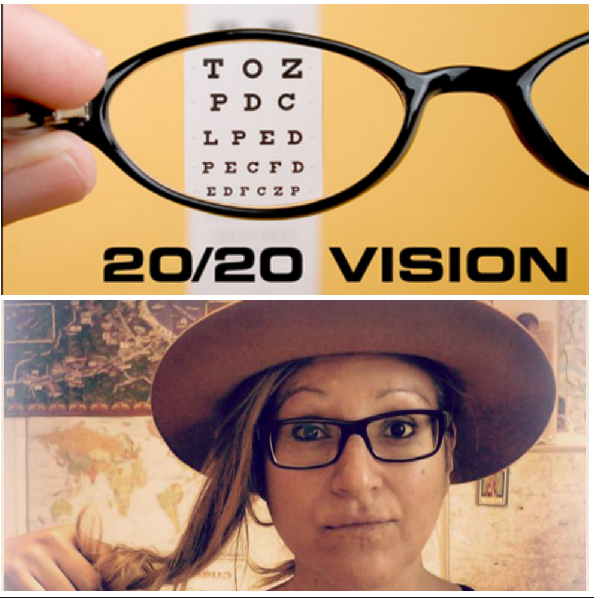






 periMENTAL