
Category: New York
ADVICE: Should you ever fall or get pushed into the subway tracks…
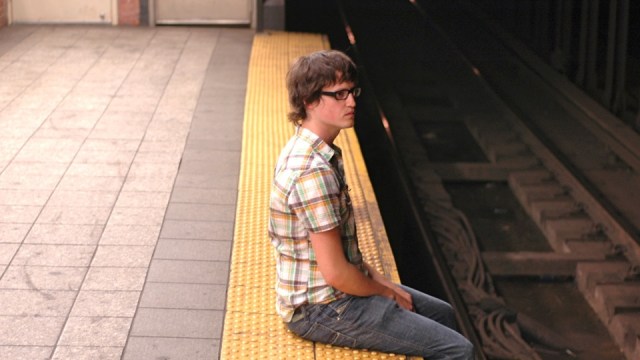
It doesn’t happen often, but when it does, it’s horrific. On Dec. 3, a man was pushed into the subway tracks and killed. Here are some tips from my friend Rich, who as a former graffiti writer, has been on the subway tracks, as well as inside the tunnels:
If you happen to fall or get pushed into the subway tracks:
– If you don’t hear a train coming down the tunnel, and don’t see any lights, you can try to climb out of the tracks.
The height is a lot higher than you may think, and will take some real effort. Hopefully someone can help you out. Take off any backpacks/bulky coats (again, assuming you have time. There is a difference between falling into a subway track at 5:30 pm and 3am).
-If you can make it to either end of the track, it might be a little easier to climb out using step railings. Go to the end that the first car would end up at, since you have a better chance of the train stopping by then.
– If the train is barreling down the tunnel, and you have no time to climb out, don’t freak out and keep reaching out, or if someone who is trying to pull you up is not able to, make them let go. You do not want to be caught half-way up as the train crushes you between platform and subway car.
What you want to do is lie down FLAT and STRAIGHT, AGAINST the wall UNDER the subway platform. Don’t curl up, and this will push you out closer to the train.
There is a relatively good amount of space under there.
The train will likely stop, and likely not move until rescue teams arrive, though perhaps some MTA workers might try to come to you to make sure you’re ok.
Don’t try to crawl out unless you are directed to do so in a safe manner.
Yes, it’s dirty and disgusting down there, but it’s a lot better than being crushed into human Spam.
Do not try to lie down in between the track rails to let the train go over you.
While there have been cases of people surviving this way, there are mechanical components underneath the train carriage that can snag up on your coat or backpack and drag you, causing you serious harm.
As you all know, there is a live 3rd rail, usually against the opposite wall from the platform. The electricity on this rail will KILL you.
But if for some reason, you end up stuck on this side of the track when the train is barreling down the tunnel, the rail usually has a wooden beam over it that is *safe* to step on.
(By *safe*, I mean it’s certainly better than stepping on the metal of the 3rd rail itself).
Hopefully, this beam is structurally sound.
You will also notice there are indentations on the wall. If you stand up super pressed against the wall in these gaps, you have a much better chance of not being hit.
(If you are wearing a backpack/purse, remove it. Throw it away. It’s not worth getting tangled over).
— Extra tip:
If you are trying to hold the door for your kid/friend, etc, most people’s arm strength cannot stop the doors from closing. You can get caught and dragged.
Use your foot (hopefully with a sneaker or boot, and not heels on it) at the bottom of the open door. This provides a lot more friction to stop the doors from closing than trying to use your hands/arms.
— Extra extra tip:
If you are inside the subway tunnel, it is far more deadly in there, as the gaps for safety are much much smaller.
It’s a lot more difficult to see where the 3rd rails are, and the trains will be zooming by a lot faster.
If you are in there for some reason (which I can’t imagine why, unless you have a can of silver spray paint or are escaping from zombies),
some paths have elevated platforms against the wall. Lying flat against the wall on these platforms will help with you not getting hit, but it’s a close shave.
If you don’t extend beyond the edge of the platform (again, watch out with that backpack), you should be ok. Beware of the “suction” the train forms when it zooms by you. It can pull you into the moving train.
Though I’m 6’2 and 230 lbs, I don’t sleep on the subway platform.
Whether it’s kids/gangs acting stupid, or some mentally deranged individual having a violent fit, I don’t sleep on anyone. Even with headphones on, I keep an eye out, and watch out for who is around me.
The man who was recently killed by that train could have survived if he just lied down beneath the platform.
He probably had no idea, and thought the only chance was to climb out.
A little info can save your life.
Peace.
Help Long Beach #Sandy victims during the holidays!
 via Liz Caldas & the “Sandy Help LB” group on Facebook:
Moms & Dads! Help your kids connect with kids on the ground and still in the dark in Long Beach. Send in cards like these and they will be included in stockings….or stuff your own stockings and send to: 120 West Park Ave Suite 103 Long Beach NY 11561….no later than December 10th.
Stockings could have headlamp-flashlights, prepaid VISA or Home Depot cards, deodorant, anything else you think could help and fit in a stocking.
Reuters: Red Cross response to Sandy fails to meet expectations
 This excellent article by Reuters reveals “a gulf between what many people expected the [American Red Cross] to do in times of crisis and what it actually delivers.”
Key points:
Like Hurricane Katrina victims, Hurricane Sandy victims feel let down by the charity.
From the article:
— The sense of letdown is all the more stark because the Red Cross, the fifth-largest charity in the United States by private donations, is viewed by many as the place to donate money when there is a major disaster at home or abroad.
— Part of the perception problem may be the massive media and advertising campaigns that the Red Cross runs when there is a disaster.
— These campaigns appear to give the impression that the charity can be all things to all victims. Many of Sandy’s victims said in interviews that this was their view before disappointment set in.
— Frustration with the Red Cross is palpable throughout the Occupy movement.
“The Red Cross is useless,” said Nastaran Mohit, who runs the Occupy medical clinic in the Rockaways with volunteer doctors. “They come to me every day asking, ‘How can we help?’
“I say, ‘Send me people.’ And they tell me they’ll get back to me.”
Read the entire article here.
Rockaway Beach Surf Club: Kicking ass & taking names in Sandy relief
If Hurricane Sandy has proven one thing, it’s that grassroots efforts can sure as hell get things done. Even better, they can work side by side with agencies such as FEMA, the American Red Cross, and even the National Guard, to help those affected by a disaster. In some cases, as you’ll see below, it seems like they’re leading!
The following Reuters Investigates video is about the Rockaway Beach Surf Club‘s well-oiled Hurricane Sandy relief machine in the Rockaways. Makes you wonder: what else could they be running?
I linked to the Rockaway Beach Surf Club here. You can also check out Rockaway Relief for ways to help.
The New Revolution: The Grassroots Efforts of Hurricane Sandy Relief
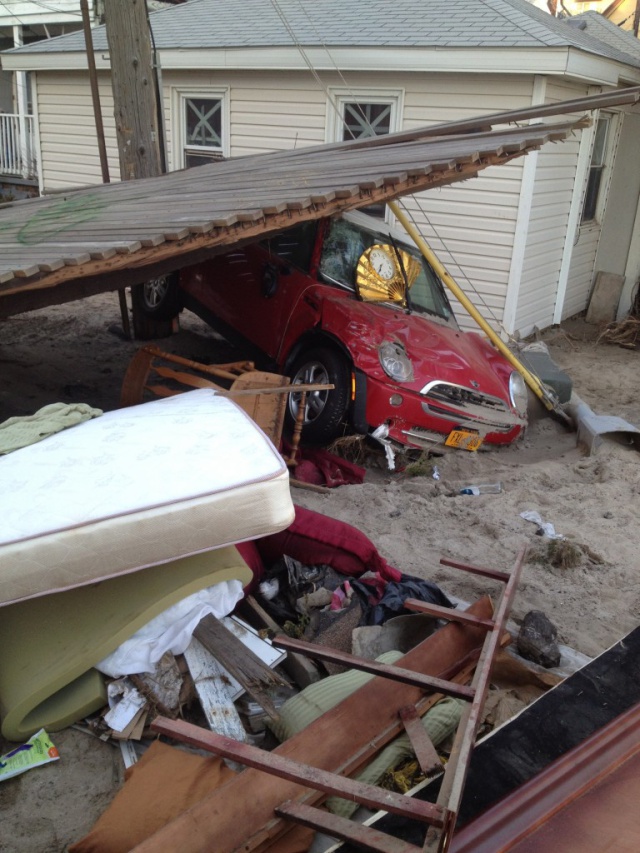
by Veronica Varlow via Danger Dame
I don’t even know where to begin.
But I know this needs to be written.
This is what I learned this week: We are at the helm of our world community thriving or dying. Know this.
Down at Beach 23 and Seagirt Blvd in the Rockaways, the five of us, jammed in a 1990 Mazda 323, on top of 2 generators and a pump to empty basements of water, pulled up to a parking lot.
Sixty people came running to our car, surrounding it. “Do you have blankets? Please, we’re freezing!”
We had two left to give.
Read the rest of this great account of grassroots relief here.
Hurricane #sandy update: Nov. 5

First off, Mary Kate Burke updated her efforts in the Rockaways. Read that here.
Secondly, there is a paypal account (here) set up through the Knights of Columbus Council 443 that will aid their efforts. As temperatures drop (it is COLD tonight in New York City) think of the goods donating to this account will help buy.
It’s nice to see individuals stepping up. My neighbor, a New York City schoolteacher, is collected donations in our building and drove them to Staten Island with a friend. She’ll return this Saturday. And local soapmakers Daniel and Zaida Grunes of Manor House Soaps donated about 30 pounds of their yummy product to George Washington High School in northern Manhattan, where a temporary shelter was set up.
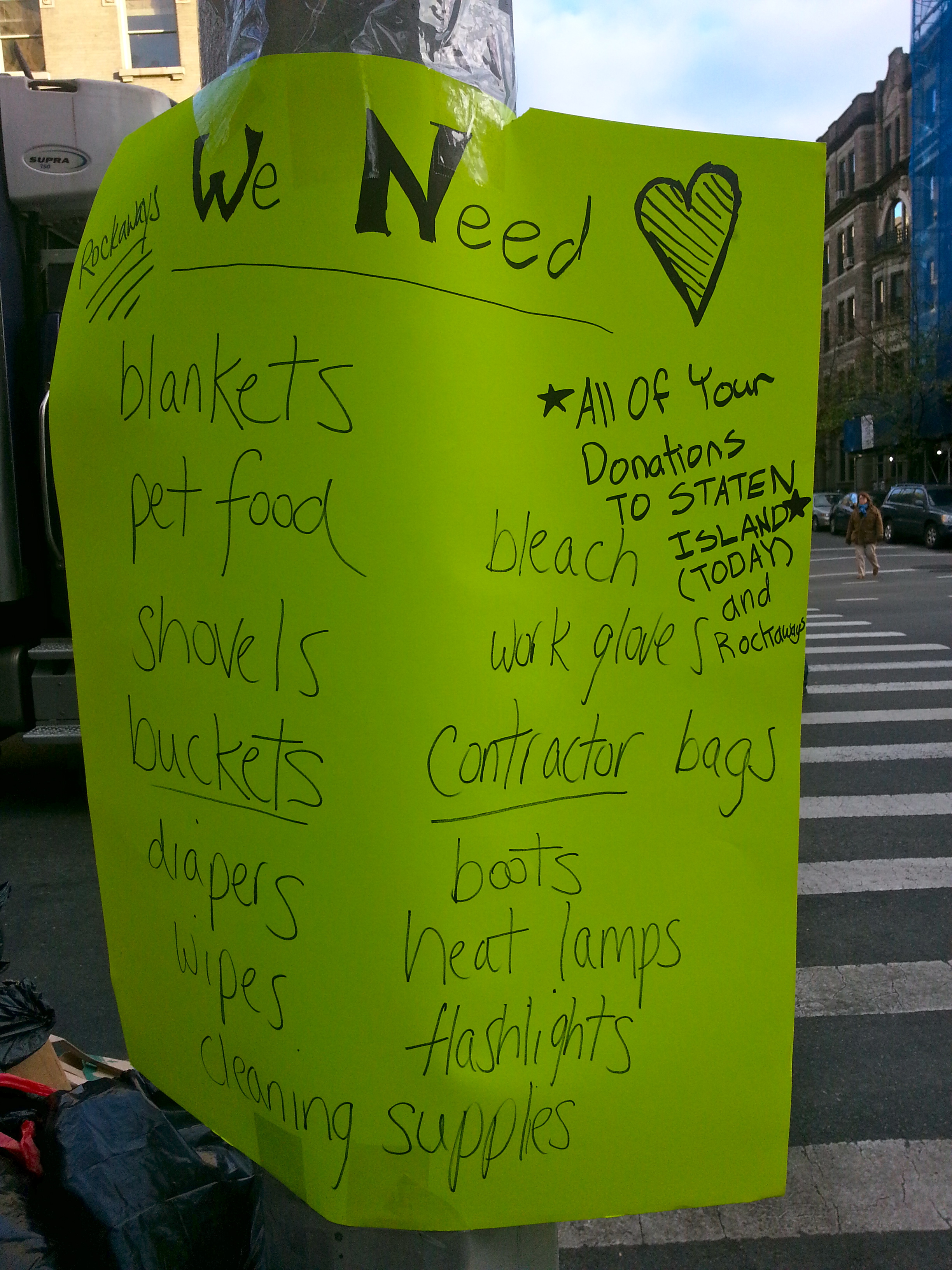
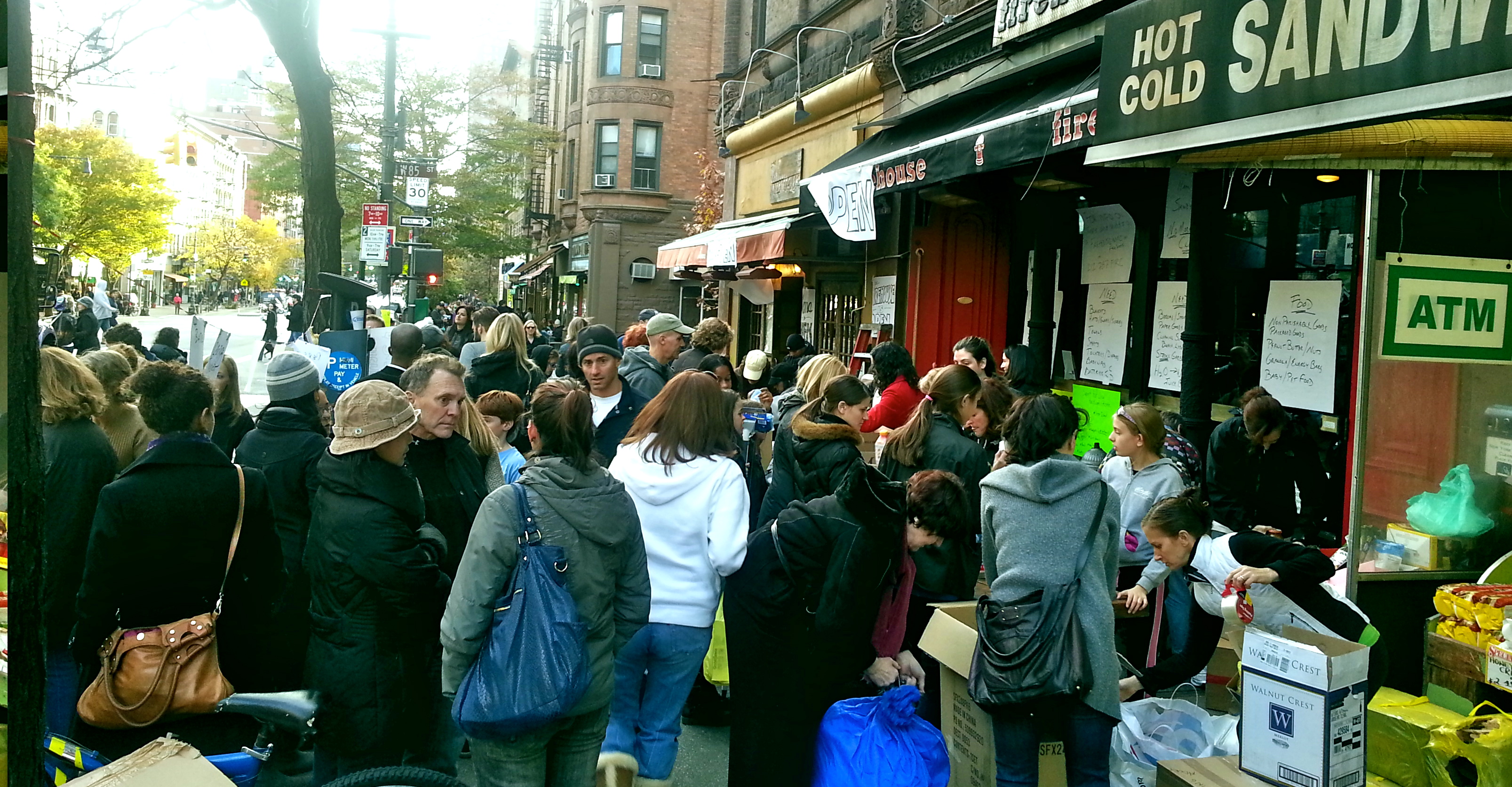
I went to the Upper West Side yesterday (Nov. 4) to drop off at a collection point organized by the Contemporary Roman Catholics and local restaurants, Firehouse and Nonna. It was PACKED. There were more volunteers than sorting space and Upper West Siders showing up with giant bags of clothing, towels, toiletries, work gloves, etc. It was nice to see that the FEMA truck being packed up was headed to the Rockaways. Truck filled earlier went to the hard hit areas of the Coney Island, Long Beach, South Brooklyn, Staten Island and New Jersey.
And because this is New York City, many restaurants, bars, bands and DJs are getting into the action.
“The Restaurant Group,” which consists of Upper West Side eateries Fire House, Nonna, A.G. Kitchen and Il Cibreo, are offering free dessert to those who bring a donation.
The folks at Remezcla are throwing an election day viewing/Hurricane Sandy collection party at SOBs. It will feature DJs Uproot Andy and Geko Jones of Que Bajo. Details here. (And then come to Que Bajo’s Fourth Anniversary party this Saturday at LPR.)
You can also head over the Bowery Electric, where the Bad Brains tribute show will also serve as a Hurricane Sandy fundraiser.
One hundred percent of the profits from Navegante’s Nov. 9 show at The Flat in Brooklyn will benefit Sandy victims.
Uptown businesses, such as APT78, Dyckman Bar, and 181 Cabrini, are collecting goods.
One of the best things I read today was this report about how many of the folks who organized Occupy Wall Street are behind Occupy Sandy. They’re even looking to expand to New Jersey. They have also set up a “wedding registry” on Amazon.com, so it’s very easy to help them!
Occupy Sandy, an off-shoot of Occupy Wall Street, has undoubtedly been a leader in spreading the word about local volunteer and donation efforts online, and thereby spurring real, tangible responses. Though certainly not a well-oiled machine by any means — seamless organization is hardly expected, anyway, in a movement that sprang up so quickly — the group’s Twitter and Facebook accounts have posted up-to-date information about exactly what is needed and where. And while the Red Cross doesn’t take donations of individual household items and certain bare necessities, these very same needs have become Occupy Sandy’s primary focus.
Read more in the Huffington Post here.

‘The Land that God and the City Had Forgotten’ -Reflections on an earlier Rockaway tragedy
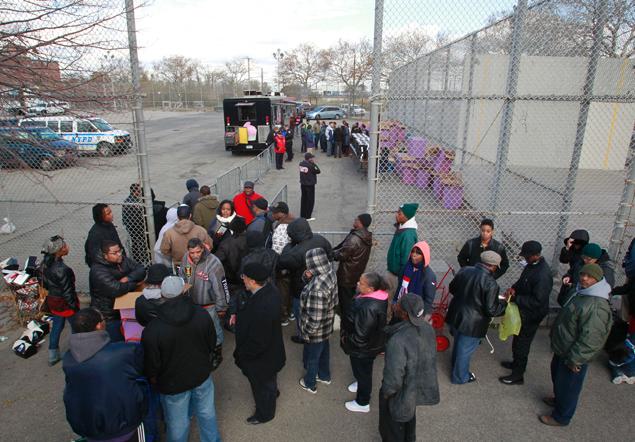
Far Rockaway residents fall in line as FEMA gives out food and water at Beach 49th and Beach Channel Drive in Far Rockaway, New York on Friday, November 2, 2012.
By Mark Naison
Professor of African American Studies and History at Fordham University
The wave of destruction that that descended upon the Rockaways in the wake of Hurricane Sandy, compounded by government neglect and the absence of official aid organizations, is not the first time that section of the city has been overcome with violence and fear. The wave of arson and disinvestment that swept through the Bronx, Harlem and large portions of Brooklyn during the early and mid 1970’s also took a terrible toll on the Rockaways, though I never saw it mentioned at the time, or for that matter in the historical literature about those difficult years in New York’s History.
I experienced this first hand in 1979 when I drove out to Rockaway to interview a former NYC school teacher and union activist, named Alice Citron, for my book Communists in Harlem During the Depression. Her address put her in a section of Rockaway, Edgemere, where I had spent many summers as a child staying in the bungalow of my grandfather, who was a garment worker. Although the bungalows were wooden, and in retrospect, extremely modest, I remember magical days and nights in that area in the early 50’s, running into the surf, playing ski-ball on the boardwalk, eating delicious knishes, and listening to the adults political arguments. The area had been packed with people, almost all of them Jewish, who had survived the Depression and were enjoying a first taste of prosperity and security. It was a joyous place.
Now, in 1979, it had the atmosphere of a ghost town. Alice Citron’s house stood on a beach block where 90 percent of the land consisted of vacant lots, with only three houses standing. Across the el tracks, near the bay side, stood a large public housing project. When I rang the door bell, Alice and her husband came to the door, accompanied by two huge dogs. Before we started her interview, which focused on the role Communist teachers played in fighting for better schools in Harlem and the teaching of Black history, she told me what the neighborhood was like today.
Rockaway had become the land that God , and the city of New York, had forgotten. In the housing projects across the street, senior citizens, most of them black, were trapped in their apartments by fear of crime. The Citrons with their huge dogs, and their car, sometimes shopped for them, and brought them to the doctor when they were sick. The neighborhood had become a kind of urban concentration camp for the poor, a place where the beauty of the surroundings was little compensation for fear, neglect, and the absence of basic neighborhood amenities. The Citrons, who had lost their jobs during the McCarthy area didn’t have the money to move out so they stayed and helped their neighbors cope. They were in their 70s then, and had no where else to go.
For years after, I was haunted by what I saw that day, and what it told me about class and race in New York City. Ten years later, when I was coaching CYO basketball, I returned with a team from Park Slope to play a game at a Catholic parish not far from the Citron home, St. Rose of Lima, but I didn’t have the time to drive around. I never found out if the neighborhood had been rebuilt, or whether life had gotten better in the projects of the Rockaway Peninsula.
Now, with reports of residents living without power, food, and water, surrounded by piles of debris the storm had scattered, terrified of crime, the memories of that visit came rushing back and along with it, the rage and frustration I had felt at the time.
Once again, the people of Rockaway were being neglected. Once again, they were reminded because of their color and economic status, they were not really “citizens.” And once again, they were living in the land that God, and the City of New York had forgotten.
Dispatch from a #sandy volunteer in the Rockaways

This was written Mary Kate Burke, an Inwood (northern Manhattan) resident who helped transport donations to Far Rockaway: (bold and italic formatting mine)
First of all, a big hearfelt thank you to the neighborhood! Your efforts today were tremendous. I am now reporting back from what we experienced/found in Queens this afternoon with all of your donations. I would like to stress that my suggestions are only meant for the areas that we went to in Far Rockaway, and that I can’t speak for other areas hit by the storm (though I have a feeling that some of my suggestions would probably help those in Staten Island, New Jersey and elsewhere).
First up, no more clothes. (*** SEE Mary Kate’s COMMENT UPDATED BELOW. The Salvation Army has stepped in to help organize donations). Several of the dropoff places we went to had stopped taking donations. There are a few reasons for this. One, there are other high need items (which I will get to) and, two, the way that we and others have been preparing the clothes for dropoff is not particularly helpful to those people who are so desparately in need.
We visited a National Guard spot on 116th Street in the Rockaways after being turned away from Breezy Point. The National Guard (at least where we were) is only manning food and water donations. Everything else is essentially being dumped out back on the ground. Local residents are sifting through garbage bags and grabbing the few diapers and wipes that are there. There is no organization. (So, please no more clothes for now until we figure out a better system).
When we first arrived at 116th Street, we spoke to a cop and a resident who encouraged us to set up our own makeshift spot on 65th Street. Ify, the local resident who was at 116th Street with her husband and several large bags of supplies to bring back home, told us that she would lead the way, so we crammed her and some of her stuff into the Inwood Caravan (we left the husband behind) and headed down to 65th Street. As we got closer, Ify started bellowing out of the car, “These people have a truckful of shit for us!”
We arrived on 65th Street and it was a ghost town. She rallied some neighbors including several older residents who had already been at work “organizing the community,” including a council man of some sort. Don’t quote me on council man but he had some kind of leadership role. He also lived on the block.
There was no fire station. There were puddles and a scarcity of dry places to unload. And there was no National Guard. We started organizing. “You can put the water on my steps!” “Baby stuff over here!” etc…. And then the people started coming.
Council man had them line up at first and wait until we finished organizing and unloading but that only lasted so long. How could we tell these desperate people to wait any longer?
All of the food went. As did all of the toiletries, diapers, etc. Basically everything went except half a truck of clothes. We learned that things get a little dicey in parts of the Rockaways after dark and we were working against the clock.
Ultimately, Mr. Council Man told us to put all of the clothes back into the truck and try to take it somewhere else. This was tricky. We piled back into the Inwood Caravan, taking Ify with us. She helped direct us to places that were makeshift spots organized by civilians. They didn’t want any more clothes. Many of them were hipsters who had biked in to volunteer and had no way of dealing with the already overwhelming number of garbage bags of clothes. Let’s hope it doesn’t rain anytime soon.
We eventually went back to the 116th Street National Guard station and thankfully were able to leave them there after we realized that Salvation Army trucks were rolling in and collecting in response to the overabundance of clothes. Phew.
Here is what people need in Far Rockaway. (Remember, there are no traffic lights, power, water, etc., for miles.)
1. Diapers!!! After we ran out (and several people asked for them), Jaimie and I hightailed it back up to 116th Street and I grabbed the few boxes that were there, threw them in his car and brought them back. They need all sizes. I can’t tell you how many people asked for the newborn size which broke my heart. People asked for all sizes though.
2. Wipes. For the same reason as above, but they need more wipes because I am sure they are serving double duty. To wipe babies’ bottoms, but to also clean adults.
3. Batteries! All kinds. We had very few and they needed them. Including a man who used a device to speak through his throat and was worried that the battery which operated his device was going to die soon. I didn’t have a nine volt to give him. They also need batteries for flashlights and radios, and I’m guessing some elderly folks would need hearing aid and other specialty batteries.
4. Flashlights! Many asked for those and we had very few.
5. Tampons!!!
6. All kinds of toiletries.
7. Toys, coloring books, crayons, and fun stuff for kids. We ran out of toys quickly and towards the end, a five year old little boy asked me if we had any toys (for him) or diapers (for his younger sibling) and I had to say no. Talk about a knife in the heart!
8. Juice boxes, healthy snacks, baby food…..
9. Water.
Here is the deal. We need to organize another Inwood Caravan. But, we need to organize the items more effectively next time. Buying in bulk is great and cost effective for us, but not so much for those in need.
—-
By the way, for more details on how Rockaway residents are doing, check out this article in Global Grind.
PHOTO: #sandy #RockawayBeach #OldGlory
 Nov. 3, 2012–Rockaway Beach, N.Y.
Taken by my friend and colleague, Kraig DeMatteis, who was there all day cleaning out his parents’ and sister’s houses.
 periMENTAL