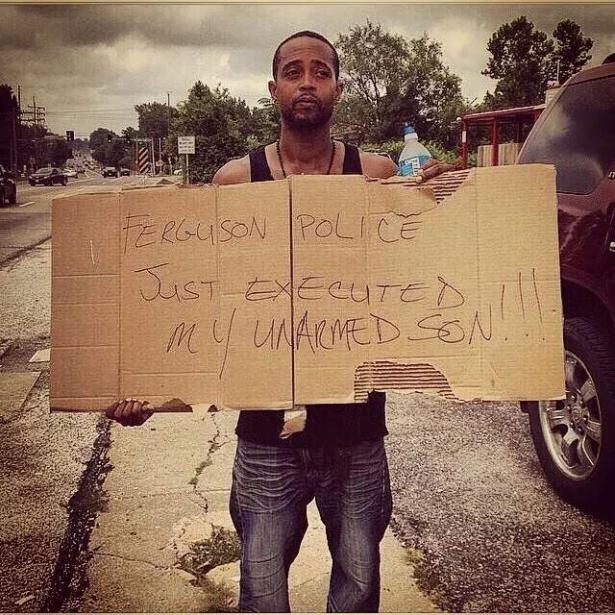

The shootings of Michael Brown and Eric Garner, and the ensuing debate surrounding the killings and related protests, caused some of my friends, and obviously, people in general, to respond in a way I soooo dislike:
- “Why don’t they protest when they get shot by one of their own?”
- “Why doesn’t the media make such a big deal about black on black crime?”
These questions are problematic for several reasons that have been aptly outlined by both columnists like Ta-nehisi Coates (“The notion that violence within the black community is “background noise” is not supported by the historical record—or by Google. I have said this before. It’s almost as if Stop The Violence never happened, or The Interruptors never happened, orKendrick Lamar never happened. The call issued by Erica Ford at the end of thisDo The Right Thing retrospective is so common as to be ritual. It is not “black on black crime” that is background noise in America, but the pleas of black people.”) and academic scholars (“Giuliani presented no evidence that Black communities are not actually addressing violence in their own communities. It’s also useful to point out that based on the most recent crime statistics from the FBI in 2011, the White-on-White murder rate was .0014% of the population, while the Black-on-Black murder rate was .0069% (with rounding), a difference of .0055%.”) who can be found with a quick Google search.
These comments also demonstrate a complete lack of empathy on their part, which I can only attribute to ignorance, as in legitimate naiveté about the majority of folks who live in high crime areas, and what they really want. My guess is they must not know too many families affected unnecessary violence, be it on the victim or perpetrator’s side.
Lastly, they must not understand that, although it seems the media is ever present, thanks to the 24 hour news cycle and budget cuts due to the Internet and what it did to print journalism, resources within media organizations aren’t what they used to be. Gone are the days when a journalist would be assigned to cover crime in every single town.
As a newspaper reporter, I remember what it was like to camp outside of a victim’s home in hopes of catching a family member for a quote about what they were feeling. (It was not my favorite part of the job. Many times dreaded those interviews.)
Do people really think people living in high crime areas are happy about the state of their neighborhoods? Or that if someone gets killed next door, it’s no big deal? It’s so much deeper than that.
LUCKILY for us, journalist Jill Leovy has a new book in which she studies the epidemic of unsolved murders in African-American neighborhoods and the relationships between police and victims’ relatives, witnesses and suspects. I’m looking forward to this book, because it’s clear it’s not just from the perspective of victims, but it covers how the police respond to crime in tough areas.
The idea for Leovy’s book came from a blog she started (The Homicide Report) back in 2006 while working for the Los Angeles Times. In her new book, Ghettoside: A True Story of Murder in America, she examines one of the most disturbing facts about life in America: that African-American males are, as she puts it, “just 6 percent of the country’s population but nearly 40 percent of those murdered.” (source.)
In this recent interview with NPR’s Fresh Air, she discussed how she managed the carnage and the pure emotion of family members of murder victims she came across as a reporter for the Los Angeles Times:
“It’s not the carnage that’s horrible, though. It’s the grief and the sadness of it that is – that will make your hair stand on end, and that is very, very difficult to deal with. The actual fact of bodies and blood is much easier to deal with than what you find when you go to somebody’s house five years later and they’re still shaking and weep instantly when you say the name of their loved one.
In fact, “The Homicide Report” was the easiest homicide reporting I did in all my years of homicide reporting, and there was a reason for that. And I knew it going in. I think in some ways, at that time, I needed it. It’s because mostly, I was dealing with victims’ families right after the homicide. That’s a time when – in the normal course of reporting, that’s when you usually meet victims’ families – that first 48 hours, that first week, maybe, before the funeral, and, you know, that’s the easiest time because people are in shock. They are in a state of suspended disbelief. They don’t know what to think. They’re kind of frozen and wide-eyed, and it takes time with something as traumatic as homicide for the reality to sink in. And so it’s a lot harder to interview people three months later, six months later. Two years can be a really grueling point, I found – five years, very, very grueling. Homicide grief is very distinct, I think, from other kinds of bereavement, and the trajectory of it can be different.
Another great part of this Fresh Air interview with Leovy is her insight into how police handle these crimes, and how they’re viewed by these communities. Simple it is not:
“Police hear that all the time: ‘You don’t care because he’s black. You’re not going to solve it because he’s black.’ And it’s very interesting, I – in terms of Ferguson and some of the other recent controversies – I was thinking that this is so complicated because there is, very definitely, a standard black grievance against police that you hear in South LA, that has to do with the generally understood problem – too much consent searches, we say, in LA, too much stop-and-frisk, too heavy of law enforcement, too much presumption of guilt when you take stops.
What I hear, when I’m in these neighborhoods, is a combination. It’s a two-pronged grievance. There’s another half of that. And the other half is, I get stopped too much for nothing, and the police don’t go after the real killers. They don’t go after the really serious criminals in this neighborhood. They’re stopping me for what I’ve got in my pocket, but I know someone who got killed down the street. And they haven’t solved the homicide, and yet, that second half seems to never break out and make it into the national dialogue about it. To me, it has always been that double-sided grievance of too much of the wrong kind of policing, not enough of the policing we actually want in these neighborhoods.
Hear the audio interview, or read the transcript, here.

And check out these other related stories, including one where a 17-year veteran of the LAPD says community members can stop police brutality by cooperating with police, and this one, in which the architect of ‘Broken Windows’ defends his theory.