
Photo by: Pablo Andrés Sandoval Vargas

Photo by: Pablo Andrés Sandoval Vargas
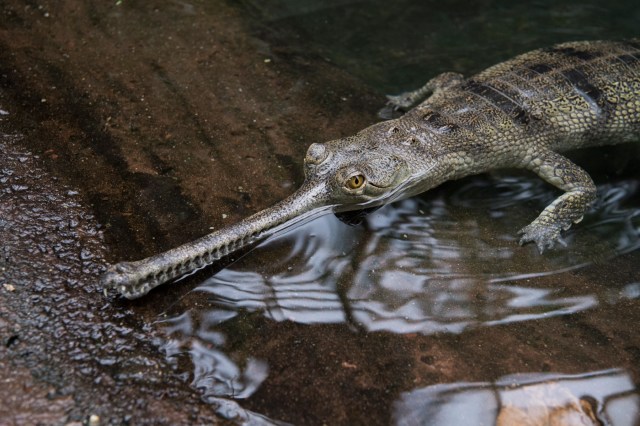
Julie Larsen Maher © WCS
I go to the Bronx Zoo at LEAST once per year, but the return of these interesting guys guarantees a summer 2017 visit!
Critically endangered Indian Gharials have returned to the Bronx Zoo for the first time in 25 years.
Gharial are a slender-snouted crocodilian native to northern Indian subcontinent. They are classified as Critically Endangered by the International Union for the Conservation of Nature (IUCN). Eighty percent of the remaining world population live in the Chambal River in India – the last stronghold for the species.
The Gharials have been added to the river habitat in “JungleWorld,” which first opened in 1985 and is one of the marquee exhibits at the Bronx Zoo. It is an award-winning indoor Asian rainforest that features several multi-species habitats that create a total immersion experience for guests.
The “JungleWorld” river already serves as home to turtles and fish native to Asia. White-cheeked gibbons, mouse deer, Indian fruit bats, painted storks and numerous other species of birds can also be seen along the river’s edge.

Julie Larsen Maher © WCS
WCS’s Bronx Zoo is open daily from 10:00 a.m. to 5:00 p.m. weekdays, 5:30 p.m. weekends from April to October; 10:00 a.m. to 4:30 p.m all days November to March. Adult general admission is $19.95, children (3-12 years old) $12.95, children under 3 are free, seniors (65+) are $17.95. Parking is $16 for cars and $20 for buses. The Bronx Zoo is conveniently located off the Bronx River Parkway at Exit 6; by train via the #2 or #5 or by bus via the #9, #12, #19, #22, MetroNorth, or BxM11 Express Bus service (from Manhattan that stops just outside the gate.) To plan your trip, visit bronxzoo.com or call 718-367-1010.
WCS (Wildlife Conservation Society) MISSION: WCS saves wildlife and wild places worldwide through science, conservation action, education, and inspiring people to value nature. To achieve our mission, WCS, based at the Bronx Zoo, harnesses the power of its Global Conservation Program in nearly 60 nations and in all the world’s oceans and its five wildlife parks in New York City, visited by 4 million people annually. WCS combines its expertise in the field, zoos, and aquarium to achieve its conservation mission. Visit:newsroom.wcs.org Follow: @WCSNewsroom. For more information: 347-840-1242.

There’s Bill. There’s Hillary. There’s Chelsea. And now, meet Tyler Clinton. The nephew of the former President and former Secretary of State, 22-year-old Tyler is the son of Bill’s half-brother. He’s nearly six feet tall, just graduated from college and moved to New York, and appears to have inherited the family genes of drive to…
via Hillary Clinton’s Model Nephew Knows How to Strike a Pose — TIME

Peter Stults, creator of the “What If?” movie poster series that drop classic actors into modern blockbusters, tried his hand at a movie poster for a movie that doesn’t exist.
Enter: Idris Elba in “The Apostle of Ireland: The Saint Patrick Story”
I love the concept. Of course, I’d love Idris Elba to star in everything.
See more of Stults’ work here.

In the northern reaches of the Andes — where the coffee bean is as
central to life as corn is to small town Iowa — a welcoming spirit prevails.

Sacks of coffee in the Delos Andes cooperative.
Credit: Federico Rios Escobar for The New York Times
///////
 I love milk and dairy products (cereal o’clock is one of my favorite late night habits), so I would be so upset if I were ever to become lactose intolerant. You can learn all about lactose intolerance, which basically forces some people to have to forgo most dairy here.

I eventually discovered that I could take Lactaid pills with dairy, but they never made me feel good, and my beloved jerk room mate would make fun of me for being “lactarded.” I wanted to understand more about my body, so I started researching what lactose intolerance is — and I learned that while 10% of people with Northern European ancestry have problems with dairy, as much as 60% of our diverse US population at large has problems. But all Americans love eating cheese; on average we eat 34 pounds of the stuff every year.
What I realized was that Lactaid medicalizes, and stigmatizes, a common condition. If you’re lactose intolerant, there’s actually nothing “wrong” with you: it’s normal. So with Milksugar I set out to do two things: create a normal lactase enzyme supplement pill for normal people, and then also to… let nature in.

I think that big corporations believe Americans are too wimpy to knowingly eat cool Japanese mushroom pills that help them digest dairy. I have a more optimistic view of my countrypeople: I think they will like to know! Because nature is really, really cool!!
2) What’s the best thing about being your own boss?
Well, I can sleep in and stuff. Also I can entertain myself with notions of earthly riches. I’m more inclined to think of myself as an entrepreneur than as a boss. It’s a distinction that makes a difference. I’m terribly impulsive; I don’t command myself, so much as I am drawn forward by curiosity and vision. In that way, I am a servant.
And that’s the best part — the freedom to pursue the dream!
3) What’s one of the hardest things?
Well, I’m not a rich kid, or in possession of vast savings, so there’s been some financially tight moments. How terrible — I have had to live off rice, and sometimes recycle my better-remunerated room mates cans for beer money. Oh, woe is me (I’m joking, although having money to go out is fun). It’s more seriously stressful to be late with the rent. Obviously, as a start up business with not too much sales volume yet I should worry about failure. But the truth is that I don’t.
In the back of my mind I have been preparing to do a project like this for awhile. I am very fortunate to have some truly amazing and inspiring friends, teachers, and investors who have walked similar paths. I wouldn’t be doing this without them.
The hardest task for me has been setting the correct expectations for myself, and remaining mindful. I can be very impatient, but changing the way an entire culture thinks about lactose intolerance won’t happen overnight.
That said, I think we can win.
Susan is a food, travel and lifestyle writer. See her stuff here.

 periMENTAL