Haven’t updated music news in a while, so here goes…
The Brooklyn-based psychedelic salsa band, La Mecanica Popular, have released a new video for their single, “La Paz del Freak.” Great song and I’m pleased I have a CD for my dad. The man loves his salsa. Always has. Check out the video, and read about the meaning of the song, on Sounds and Colours! And if you’re in NYC, check them out at Lit Lounge on the 21st.
La Mecanica Popular. Photo by Gina Vergel
My homeslice Christian Vera from Chicago’s SOULPHONETICS crew sent me a beautiful mix. It’s got some sultry Brazilian tunes in it and, to me, that equals love. Close your eyes, pretend you’re on a beach in Rio, and listen here. (Free download, too!)
Photo via Soulphonetics on Facebook.
In the wake of Isabela Raygoza’s great “20 Spanish-Language MCs Everyone Should Hear” article in MTVIggy this week, Christian Vera turned me onto a Puerto Rican-by-way-of-Chicago rapper, the Color Brown. I always appreciate an emcee who can rap clearly the whole song through, so lyrics are truly heard, so I’m a fan upon first listen. I plan to explore more, though. There’s a lot on his Soundcloud.
Start off with this track, “Exilio,” since it opens with the sound of the coquí, and that made me miss Puerto Rico.
Elvis Costello has released a new album with The Roots. I repeat: Elvis Costello and The Roots. Listen to this wonderful collaboration via WFUV.
Throwback Thursday. This remix by Uproot Andy shuffled onto my earbuds last night when I was walking my dog. “El Botellon” was released on Bersa Discos in 2008? Is that right? All I know is I always requested it the year I first met him, which I believe was 2011. (And he obliged. What a guy!) The track ever gets old.
Finally, I’m on a real soul kick. Charles Bradley! Lee Fields! Take me to a Daptones party! (Or the next best thing. Charles Bradley and more at Williamsburg Park on the 2oth.) Watch this 2011 performance of “Why Is It So Hard?” from a live session (backed by The Menahan Street Band) on KEXP in Seattle. Phew! Deep lyrics.
Among the many things I love about my job at Fordham University is that I get to deal with academics on a daily basis. Sometimes, I sit in on their classes. One of the most interesting professors is Mark Naison, professor of history and African American Studies.
For as long as I’ve been here, he’s taught a very popular, hard to get into (due to it filling up very quickly) class called, “From Rock & Roll to Hip Hop: Urban Youth Cultures in Post War America.” It’s a class where music is heard (the rock & roll and soul stuff is GREAT) and special guest musicians give performances and mini-lectures. It all makes me wish I was an undergrad!
You can read some media coverage of Dr. Naison’s class, as well as his alter-ego, “The Notorious Ph.D., below. (Yes, Dr. Naison is known to rap.)
Check out the syllabus for the Fall 2013 semester here (bold emphasis mine):
AFAM 3134 From Rock and Roll to Hip Hop: Urban Youth Cultures in Post War America Dr. Mark Naison
Course Description:
Since the late 19th Century African Americans have exerted a powerful influence on the development of American popular music. Forms of musical expression developed in African-American communities have been reinterpreted and marketed to create the modern music industry, shaping the development of Tin Pan Alley, the Broadway musical stage, the record industry, the modern dance band, and music radio.
Until the end of World War II, racism and lack of capital kept African-American artists and entrepreneurs on the margins of this activity, denying them access to commercial venues that would reward them for their creativity and create a national audience base outside the black community. Only a handful of Black artists -Louis Armstrong, Duke Ellington, Cab Calloway, Billie Holliday, Ella Fitzgerald, Marian Anderson, Paul Robeson- had large enough followings outside the “race market”- the section of the music industry targeted to blacks- to make them truly national figures In post World War II era, however, the terms of this cultural interchange began to shift. Civil rights victories, north and south, black migration to urban areas, and the opening of new economic opportunities in industry and government employment set the stage for a new relationship between blacks and the music industry. As radio stations in major cities began to tap into the growing African-American market, black music of all types-gospel blues, swing, rhythm and blues- began to hit the airwaves.
The newest of these genres, rhythm and blues, a urban music that fused sweet harmonies and powerful dance beats, sparked a musical and commercial revolution by attracting a huge underground audience among whites. By the early 1950’s, “black” music radio from Memphis to Los Angeles was attracting hundreds of thousands of white listeners, most of them under the age of twenty five, and sparking an unexpected growth of record sales for artists who had only aimed for the “race market.” In several cities, white disc jockeys decided to tap into this new youth audience by incorporating rhythm and blues into their formats and got such a huge response that they made it the centerpiece of their shows.
Calling it “rock and roll,” they marketed it as youth music rather than black music and looked for white artists who could play it to supplement the already established black stars. This marketing strategy was brilliantly successful. By the early sixties, rock and roll had become the musical language of a generation of American youth, crossing racial and cultural barriers that had never previously been bridged by the music industry.
Though white entrepreneurs and artists made the bulk of the profits in this billion dollar business, scores of black artists cracked into national markets that had previously been closed to them and shaped the musical tastes of millions of young whites. Chuck Berry, Little Richard, the Drifters, the Shirelles, the Coasters, Lloyd Price, Fats Domino, Sam Cooke, Ray Charles, to name a few, were central to the early success of rock and roll, and their influence would later be built on by Motown artists like the Supremes, the Four Tops and the Temptations, and soul singers like James Brown, Otis Redding and Aretha Franklin. The terms of cultural interchange in this music were shaped by the site of its creation; the post-war metropolis. Rock and roll was the product of a long economic boom that brought blacks into the center of the industrial economy and placed them in close proximity with the descendants of white and latino immigrants. On street corners and in school gymnasiums, in clubs and theaters, in radio stations and recording studious, African-American artists and entrepreneurs mingled with musicians, producers and songwriters of other nationalities.
In the earliest days of rock and roll, the sources of creativity flowed upward from city streets, but as the music became more popular, the recording industry was taken over by media conglomerates, removing its experimental, grass roots atmosphere and separating it from its African-American roots. By the late 1960’s and 1970’s rock and roll had become typecast as “white” music, identified more with its white suburban following than its African-American originators; while African-American artists moved into niches in the music market where a modified urban sensibility still prevailed- funk, disco, soul, and pop. However, African-American and Latino youths, trapped in decaying neighborhoods savaged by disinvestment and government neglect, found themselves disfranchised by these musical developments.
In post-industrial cities where vacant lots, shuttered factories, and decaying schools marked the boundaries of crushed hopes and declining opportunities, young blacks and Latinos, supported by a small number of adventurous whites, invented a new music that fused verbal improvisation, scratching and back beats and fragments of previous musical genres into a jarring, densely rhythmic, compulsively danceable mix. Played in community centers and schoolyards, house parties and small clubs, the music initially attracted little interest from recording companies or commercial radio. But its extraordinary popularity among urban youth soon caught the attention of neighborhood promoters, who began recording the music, and hip audiences in the largely white downtown “punk” scene.
By the early 80’s, hip hop or rap, had started to crack into mass markets and commercial radio, even though most established professionals didn’t regard it as real music. But the music accurately expressed the sensibility of people who had been left out post-industrial social order or who were rebelling against its mores. Hip hop, despite fierce skepticism and opposition, not only survived, but exploded becoming the most commercially successful musical form in the world by the mid-90’s, defining not only the sensibility of urban youth in the United States, but young people of various backgrounds all over the world.Once again African-American cultural creativity, forged in an urban setting, had redefined the musical tastes of a generation.
In the course that follows, we will examine how the sensibility and musical creativity of urban youth, in two very different historical periods , inspired musical revolutions which transformed the tastes of entire generations, crossing boundaries of race, gender, nation and social class. How could this happen twice in fifty years? What does this say about the racial/cultural dynamics of post-war American society? About the connection between African-American culture and American culture? About race and gender dynamics in the culture industry? About the role of women in musical forms which emphasize an insurgent, eroticized masculinity and turn women into objects of desire and/or contempt? About how rebellion can be marketed, coopted and turned into an instrument for material gain?
To get at these questions, the course will use music, film, and literature as well as historical writings on the music industry and contemporary urban life. To add depth to our portrait, we will also explore musical countercultures of international derivation particularly punk, reggae, salsa and reggaeton, and look at how folk music and jazz periodically invade and occasionally shape popular musical forms. We will also explore how these musical forms become internationalized and how they are being brought to life today in new ways in nations around the world.
We have a graduate assistant working with the class, Melissa Castillo Garsow, who will give a few lectures and presentations on the globalization of hip hop. At various points in the class, people involved in the creation of the music we are studying will come to class to perform or talk about their work. There will also be an opportunity for students in the class to perform their music, inside or outside of class. We draw no line between musical creativity and musical analysis. Both are welcome in our classroom.
I. An Overview of Popular Music in the US: Garafalo and Waksman Rockin Out, Introduction
2. Some Antecedents of Rock and Roll: Garafalo and Waksman, Rockin Out, chapters 1 and 2, Rock and Roll, Race, and the invention of the “Teenager:” Garafalo and Waksman, Rockin Out, chapters 3-5 Echols, Scars of Sweet Paradise, chapter 1
3. Soundtrack to Social Revolution, Soul Music, Civil Rights and the Rise of the Counter Culture: Guralnick, Sweet Soul Music, 1, 3, 4, 5, 7, 10, 11 Echols, Scars of Sweet Paradise, 2-7 Garafalo and Waksman, Rockin Out, chapter 6
4. Black Power, White Flight and the Resegregation of Popular Music: Guralnick, Sweet Soul Music, ch. 12 Echols, Scars of Sweet Paradise, 8-9 Garafalo and Waksman, Rockin Out, Chapter 7, Mid-Term Examination
5. The Rise of Hip Hop: Creativity and Destruction in the Post-Industrial City: George, Hip Hop America, chapters 1-2, Foreman and Neal, That’s The Joint, selections Mark Naison “The Morrisania Roots of Hip Hop Culture” (article sent on internet) Mark Naison “From Doo Wop To Hip Hop” (article sent on internet)
6.. Caribbean and Latin Influences in Hip Hop Culture: Foreman and Neal, That’s The Joint, selections, Class Presentations/Lectures by Melissa Castillo-Garsow
7. Images of Rebellion: MTV, Music Videos, and Commercialization of Rap: Garafalo and Waksman, Rockin Out, chapters 8, 10 George, Hip Hop America, chapters 3-4, Foreman and Neal, That’s The Joint, selections
8. The Crack Epidemic and the Rise of Gangsta Rap: George, Hip Hop America, chs. 5-10 Foreman and Neal, That’s The Joint, 11, 17, 26, `44, Jay Z Decoded
9. Hip Hop Wars: Gender, Sexuality and the Politics of Contemporary Rap: George, Hip Hop America, chs. 11-18 Foreman and Neal, That’s The Joint, selections
10. The Globalization of Hip Hop: Foreman and Neal, That’s The Joint, selections, Class Presentations/Lectures by Melissa Castillo Garsow
Kansas City’s Making Movies joins Mark Lowrey & Hermon Mehari as they become Making Movies Social Club for the night.
“We play old traditional Latino music from Cuba, Puerto Rico, Colombia, Peru, Panama, and Mexico, and revamp some of our stuff in the acoustic format,” says lead singer, Enrique Chi. “We are going to make a record. It should be fun.”
Saturday, May 11, at the Kill Devil Club in Kansas City. Doors at 7 p.m.
$10, 21+
This event will sell out, so grab your tickets here.
Upcoming Summer Album, Double-Disc “El Negrito Dun Dun & Ricardo,” Coming Later This Summer
Kickoff National Tour With Internationally Renowned Reggae Band – SOJA – in San Diego on Wednesday, April 24.Confirmed To Perform With Tego Calderon at Summerstage in July During the Latin Alternative Music Conference. Win Puma’s “Blank Canvas“Project, Raka Logo On Major Brand Sneaker. Make A Cameo In Macklemore’s “Can’t Hold Us” Video!
“Already known as mixtapes wizards before they started recording their own songs, Los Rakas concocts a bilingual gumbo from the Caribbean musical diaspora of Jamaican dancehall, reggaeton and reggae, stiffened with straight shots of hip-hop and R&B.” – LA Times
“The illusion of effortlessness is part of what makes them so cool, and they generate inspiring mega-wattage the way most people barely wake up. There was no need for the comic aggression, transparently defensive displays of wealth, or an authenticity that sounds a lot like sociopathy. They perform from a meaningful place and make it look good. Los Rakas is skill, just skill on a pocket of sunshine.” – Pop Matters
WEDNESDAY, APRIL 24th, 2013: Coming out strong in advance of their two-disc summer album “El Negrito Dun Dun & Ricardo,” the first video off Raka Dun’s (“El Negrito Dun Dun”) side of the project, “No Tan Listo” drops on the eve of a nationwide tour with internationally renowned reggae group SOJA (dates here). The album will be released on Los Rakas’ label, Soy Raka.
“Standing strong like a lion,” Raka Dun (pronounced “Doon”) calls out to a world that “ain’t ready” for the duo’s fresh take on hip-hop, dancehall, pop and experimental music in both English and Spanish. The video features Los Rakas in their native Oakland, California with Raka Dun – alongside Raka Rich and the Raka family – giving us raw Raka lyricism, ushering a new era of American rap and introducing the #SoyRaka movement worldwide!
Los Rakas have been busy since their homegrown label Soy Raka released “Chancletas y Camisetas Bordada” hitting #1 on iTunes Reggaeton/Latin Hip-Hop chart in 2011. The Los Rakas logo – Raka Smiley – is now on a special-edition Puma sneaker available at West Coast chain “Shoe Palace.” The brand collaborated with Modelo Especial and Complex Magazine for a fan-driven contest called the “Blank Canvas Project.” Up & coming artists (including Joel Ortiz) designed special edition Puma’s and fans voted on their favorite designs, with Los Rakas winning the competitiondue to overwhelming fan support.
Raka Puma: Available at Shoe Palace!
Besides being the first independent group to have their group logo on a major brand sneaker, the group has continued to put out a healthy dose of singles & videos to their rapidly growing network of international fans – called the “Raka Nation” – while building notoriety for their wildly energetic live shows. Making their Mexico debut in 2011 at Festival NRML and consequently at 2012’s Corona Capital Festival in Mexico City, Los Rakas have been expanding their movement to South America. The group has also played on national tours like Collie Buddz’s “Dark & StormyTour” in Fall 2012, while debut headlining in cities like Miami, Austin, DC, Boston and continuing to sell-out shows in Los Angeles and their native Bay Area.
The group’s most recent video, the “sexy and blunted” (Village Voice) “Bien Ribetiao,” garnered homepage placement on VEVO in Summer 2012. The song was off Raka Rich’s mixtape “El Flow Californiano: Mixtape Vol. 1.” Rich told AOL Spinner: “The style has never been done in Spanish, so we wanted to do it really well and visually have it rep all our styles being born in Panama and raised in The Bay.” A few months later, SPIN Magazine premiered the “evocative and immediate” collaboration with Caribbean clothing line RepJA – “Hablemos Del Amor” – a call to peace and ode to the young lives lost too soon like Oscar Grant, Trayvon Martin, Panamanian artist El Kid and others. Los Rakas cam be seen making a cameo in just released video “Can’t Hold Us” by Macklemore and Ryan Lewis, shot on a pirate ship in the Bay Area – the video premiered on MTV last week.
Los Rakas music has been featured recently in two episodes of FX’s ‘Sons of Anarchy‘ and HBO Latino’s ‘Sr. Ávila, 1ª Temporada.’
With “El Negrito Dun Dun & Ricardo,” the group presents a cohesive album in two discs exploring the sounds and textures of their bi-cultural twist on the globally urban Raka-sound. During a recent interview with MTV Iggy, when asked about the album’s was two discs, Raka Dun explained, “It was organic, we didn’t really plan it like that. We were each working on releasing solo projects. So we sat down and were like, ‘Let’s just release them at the same time.’‘”
On what to expect from the release, Raka Rich continued, “Dun’s side of the album is like a documentary. It’s a little more personal. The sound of the album is like dancehall reggae with hip-hop, experimental, with a little bit of jazz and soul. My side is called ‘Ricardo’ – it’s more about partying and nightlife. The sound of the CD is like Michael Jackson, ‘90s, uptempo music, feel-good stuff.”
To kick off the release of brand new music, Los Rakas will tour with SOJA across the US beginning in San Diego on Wednesday, April, 24th, traveling up through California to the Pacific Northwest. The tour continues midwest towards Chicago, with a pit-stops in Miami for the Latin Billboards and Austin for the Pachanga Latino Music Festival alongside Latin American greats like Intocable and the young electronic group out of Mexico, 3BallMTY – then back up to New York to play Webster Hall and ending in Boston on May 19th. This summer, the group will return to the Latin Alternative Music Conference (LAMC) where they won the “Discovery Artist” prize in 2010 – taking the stage at NYC’s most famous outdoor stage, Summerstage – alongside Tego Calderon.
ABOUT LOS RAKAS: Los Rakas is comprised of cousins Raka Rich & Raka Dun, pioneering Panamanians by way of the Bay Area on the frontier of a new Latin urban sound. Known for their fresh mix of Hip-Hop, Plena, Reggae and Dancehall music with both Spanish and English lyricism, Los Rakas represent the cutting edge of Pan-American flows. Taking their name from the Panamanian word “Rakataka” – a negative slur used to describe someone from the ghetto – Los Rakas have set out to both inspire fellow “Rakas” by empowering them, and to become successful despite their circumstances, turning the current Latin hip-hop world on its head. Los Rakas make music born of migration and tradition, critique and celebration, joy and pain. They make New World music. American music. Panamanian Jamaican Californian music. Music for b-boys and rude girls, dancers and romancers, mainlanders and islanders and isthmus folk alike, which continues to bubble one “Raka” at a time.
In honor of the tens of thousands of people who continue to arrive in the nation’s capital for a rally on immigrant rights today, watch the video for “Tormenta,” a song dedicated to immigrant families by Kansas City bilingual rockers, Making Movies.
The song and music video, released in 2010, shows touching images of immigrant life in Kansas City, a metropolitan area whose immigrant population doubled in the 1990s and continues to grow.
The song’s lyrics display the struggle immigrants face as they migrate to the United States for better opportunity, yet the same time, long for loved ones at home (see lyrics below.)
Making Movies continues the “A La Deriva” tour this week with stops in Dallas, Austin, San Antonio, and Houston. Dates here.
Lyrics:
Tormenta by Making Movies
Yo quiero ver mi familia esta Navidad, Y quiero hablar con mi abuelo, oír la verdad. Porque el frio me atormenta, El frio me atormenta, El frio me atormenta, El frio me atormenta.
Yo quiero ver mi país esta Navidad, Y quiero bailar en mi pueblo otra vez más, Porque el frio me atormenta, El frio me atormenta, El frio me atormenta, El frio me atormenta.
Coro: ¡No quiero estar perdido! ¡No quiero estar perdido! ¡No quiero estar perdido! ¡No quiero estar perdido!
Yo quiero comer de tu boca la mera verdad. Porque el frio me atormenta, El frio me atormenta, El frio me atormenta, El frio me atormenta.
Coro: ¡No quiero estar perdido! ¡No quiero estar perdido! ¡No quiero estar perdido! ¡No quiero estar perdido!
Yo quiero saber que va pasar contigo, ¡Déjame saber si voy a estar perdido! ¡Yo quiero crecer, cambiar este sonido! El frio me atormenta, El frio me atormenta.
My good friends up north at the Toronto-based Dos Mundos Radio have co-curated a month of wonderful programming for Hispanic Heritage Month. Check out the details below, and while you read, listen to a new track (“Wow“) by Boogat, whom Dos Mundos describes as one of “a handful of people who are actually trying to explore and redefine Latin American music in Canada.”
Dos Mundos Arts and Media will be celebrating Hispanic Heritage Month throughout the month of April of 2013 by programming exciting, forward-thinking arts and artists in the context of “breaking stereotypes with arts and culture’. This celebration is intended to make strong efforts to continue pushing the boundaries of people`s perceptions of Latin America and to also explore the idea of being Latin American in Canada.
Events for the month include ann April 2 screening of LAND IN REVOLT: IMPURE GOLD, the first installment of the environmental project by the ever-activist Argentine filmmaker Fernando Solanas tackling the plundering of underground resources and the ensuing contamination ending with Black Gold. Portraying stark reality full of scams, miseries, and corruption, Solanas targets the mining industry and open-air cyanide or explosives extraction of minerals and metals at the northeast of Argentina, and observes the reaction of the local public.
There is also a music showcase featuring alt-Latino experimental artists Helado Negro and Uladat. Taking place on April 5, these two artists play with musical genres more closely affiliated with the artful Pop Avant programming associated with the Music Gallery.
Dos Mundos Arts and Media is a Toronto-based non-profit arts organization dedicated to showcasing, celebrating and developing emerging artists and art forms that represent contemporary Latin America.
I handled publicity for Dominican singer-songwriter Vicente Garcia in February and what a pleasure it was. He is a consummate professional. Not surprising since he’s been doing his thing since he was a tween.
Garcia was taken under Juan Luis Guerra’s wing when he was just 13-years-old and fronting his own band, “Calor Urbano.”
A self-taught musician and vocalist, Vicente released his debut album “Melodrama” in 2011. Since then, he has come to symbolize the future of Latin artists who are challenging labels and redefining musical genres.
Garcia has opened for, or performed with, major Grammy award-winning artists such as Juan Luis Guerra, Mana, Juanes, Shakira and Cultura Profetica. He has also recorded with Grammy nominated, LAMC darling, Ximena Sariñana.
Check out this acoustic performance of “Te Soñe” shot by the folks over at 123UnoDosTres, a YouTube channel focused on Latino entertainers.
And more press here:
Interviewed on CNN en Español(along with a mini-acoustic performance!)
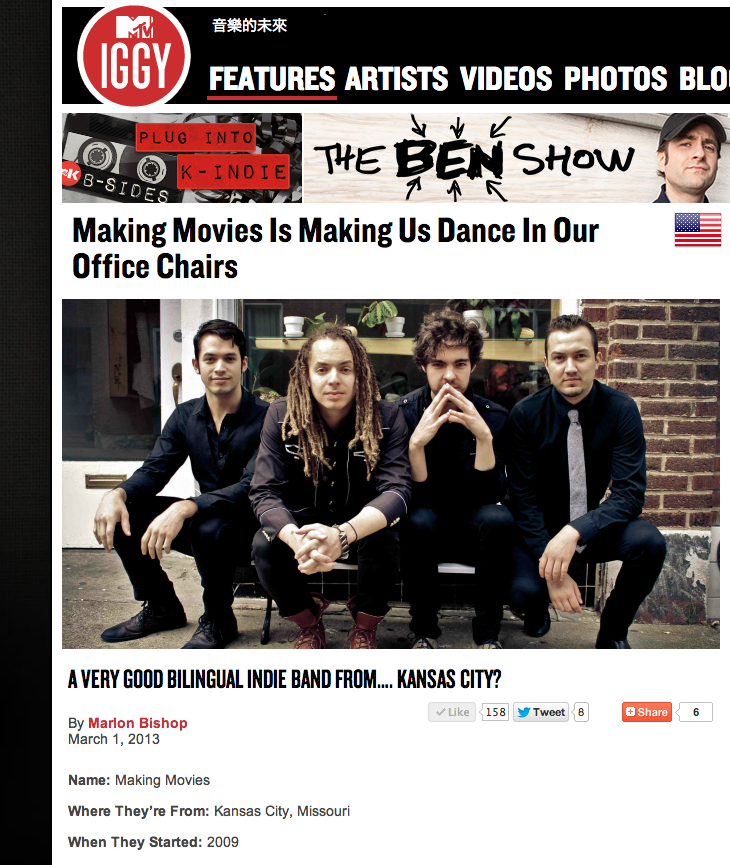
Making Movies, a band I first discovered during CMJ in New York City last year, is making waves with their new album.
“A La Deriva” is an 11-track high-energy tour de force that blends a multitude of traditionally dichotomous genres seamlessly.
The album is produced by Steve Berlin of the three-time Grammy winning, Chicano rock veterans, Los Lobos.
Together since ’09, Making Movies is turning out music that is bilingual and appealing to a WIDE audience. The kind of audience that encompasses many of today’s increasingly DIVERSE music fans, especially when you think of the growing Latino demographic.
Their music is indie rock. Alt Latino. Afro-caribbean in rhythm and percussion. Soulful. Indie. Classic in sound. New wave. It’s distinctly American, yet global.
And, as Marlon Bishop of MTV Iggy wrote last week, “… the band synthesizes what’s happening in indie rock and in Latin music better than anyone else out there today.”
Steve Berlin was first turned on to Making Movies when the guys opened up for Los Lobos at their Kansas City show. “I was struck by the effortless way they moved between musical styles, all the while managing to make each one completely their own,” Berlin explains.
Just as Los Lobos are tex-mex, cumbia, folk, blues, corrido but above all ROCK, Making Movies are a mixture of Latin music with a predominant American rock sound.
And this is why I believe they shouldn’t be considered JUST a Latin rock band.
Though they sing some of their lyrics in Spanish and use some instruments found in Latin music (not unlike Los Lobos or Bronx El Mariachi), they are an American rock band.
And that’s not all. The band co-founded a music camp for kids in underserved areas of Kansas City. WATCH this video about the wonderful impact they’re having with a diverse group of youth through music education. They’ve also been involved with DREAM act measures.
It may sound kind of idealistic on my part, but it’s what music is supposed to be. They’re making it for the fans, but also passing it on to the next generation.
You can grab “A La Deriva” at iTunes. You can also download the first single off the album, “Cuna De Vida,” over at Remezcla.
And make sure to vote for Making Movies in MTV Iggy’s “Artist of the Week” contest, which ends at 11 a.m. on Friday, March 8.
Los Rakas and Zuzuka Poderosa — artists that I’ve worked with and am a HUGE fan of, will be in Austin, Texas, next week for South By Southwest (SXSW)! Here are the details:
SHOWCASE: Listen Global. Act Local
FRIDAY || 3/15/13 || 1 PM – 8 PM
Free. All ages. No wristbands/badges required.
Kenny Dorhman’s Backyard
1106 East 11th St, Austin, Texas 78702
More than just another party, the Listen Global. Act Local. showcase is Sol Collective’s second annual meet-up for musicians, artists, activists and creatives. Listen Global. Act Local. unites premiere acts from all corners of the globe to give something back to the Austin community. “With over a million people coming into Austin for South by Southwest, we really wanted to connect with local community and support the city’s creative projects” explains Estella Sanchez, Director of the Sol Collective Arts and Cultural Center in Sacramento.
Listening global means a lineup of some of the heaviest hitters in the global music movement including A Tribe Called Red, Los Rakas, Mandeep Sethi, Sonora, World Hood, Zuzuka Poderosa, Las Cafeteras, Chorizo Funk, Sapient, El Indio, and DLRN.
More about the artists >>>>>>>>>>>>>>>>>>>>>>>>>>>>>>>>>>>>>>>>>>>>>>>>>>>>>>>>>>>>>>>>
LOS RAKAS
“Already known as mixtape wizards before they started recording their own songs, Los Rakas concocts a bilingual gumbo from the Caribbean musical diaspora of Jamaican dance hall, reggaeton and reggae, stiffened with straight short of hip-hop and R&B.” –LA Times “Their politics are refreshingly evident but subterranean to pop dazzle. Hide your teenage daughters from their energetic live show. –Village Voice
ZUZUKA PODEROSA “Baile funk flipped inside-out.” – SPIN “Not only is she bringing her own brand of the hot Brazilian underground sound to the rest of the world, but from her international vantage point she operates like a provocatively rhyming hurricane, sucking up global riddims from ghettotech to dancehall and flinging them back out at gale-force speeds.” – MTV
When was the last time that an artist put out music for women?
I’m talking about songs with lyrics that are in no way degrading to or focused on sexualizing a woman, but a series of songs that touches on issues that affect women today.
New York City’s revolutionary rockers, OUTERNATIONAL, created a buzz in 2009 with their anti-war anthem ‘Sir, No Sir,’ a protest to Obama’s troop surge in Afghanistan. In 2012, they gained acclaim for ‘Todos Somos Ilegales: We Are All Illegals‘, the bilingual concept album set on the US-Mexico border (with collaborators: Tom Morello of Rage Against The Machine, Chad Smith of the Red Hot Chili Peppers and Residente of Puerto Rican super group, Calle 13).
Valentine’s Day 2013 and they’re taking it a step further.
The V-Day event’s goal is to end violence against women and girls around the world, and the cause is backed a multitude of artists.
“We are releasing the Here is The Rose EP right now, in time for One Billion Rising and International Women’s Day, because right now millions of people, and millions of women in particular are speaking and acting out against their daily oppression – patriarchy, rape culture, sexual objectification and dehumanization,” said Outernational guitarist Leo Mintek.







 periMENTAL