Ed. note: My dad had this surgery for Parkinson’s disease seven years ago. I’m glad they now offer it for Alzheimer’s!
ScienceDaily (Dec. 5, 2012) — Researchers at Johns Hopkins Medicine in November surgically implanted a pacemaker-like device into the brain of a patient in the early stages of Alzheimer’s disease, the first such operation in the United States. The device, which provides deep brain stimulation and has been used in thousands of people with Parkinson’s disease, is seen as a possible means of boosting memory and reversing cognitive decline.
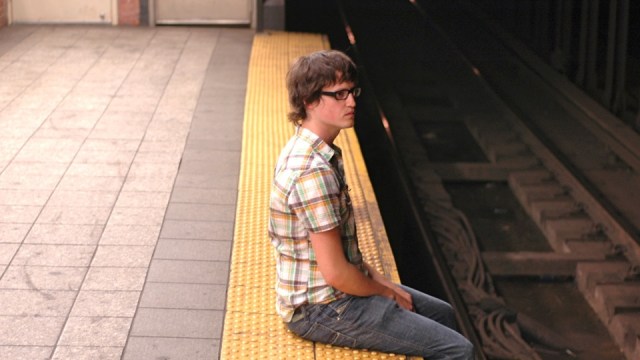
It doesn’t happen often, but when it does, it’s horrific. On Dec. 3, a man was pushed into the subway tracks and killed. Here are some tips from my friend Rich, who as a former graffiti writer, has been on the subway tracks, as well as inside the tunnels:
If you happen to fall or get pushed into the subway tracks:
– If you don’t hear a train coming down the tunnel, and don’t see any lights, you can try to climb out of the tracks.
The height is a lot higher than you may think, and will take some real effort. Hopefully someone can help you out. Take off any backpacks/bulky coats (again, assuming you have time. There is a difference between falling into a subway track at 5:30 pm and 3am).
-If you can make it to either end of the track, it might be a little easier to climb out using step railings. Go to the end that the first car would end up at, since you have a better chance of the train stopping by then.
– If the train is barreling down the tunnel, and you have no time to climb out, don’t freak out and keep reaching out, or if someone who is trying to pull you up is not able to, make them let go. You do not want to be caught half-way up as the train crushes you between platform and subway car.
What you want to do is lie down FLAT and STRAIGHT, AGAINST the wall UNDER the subway platform. Don’t curl up, and this will push you out closer to the train.
There is a relatively good amount of space under there.
The train will likely stop, and likely not move until rescue teams arrive, though perhaps some MTA workers might try to come to you to make sure you’re ok.
Don’t try to crawl out unless you are directed to do so in a safe manner.
Yes, it’s dirty and disgusting down there, but it’s a lot better than being crushed into human Spam.
Do not try to lie down in between the track rails to let the train go over you.
While there have been cases of people surviving this way, there are mechanical components underneath the train carriage that can snag up on your coat or backpack and drag you, causing you serious harm.
As you all know, there is a live 3rd rail, usually against the opposite wall from the platform. The electricity on this rail will KILL you.
But if for some reason, you end up stuck on this side of the track when the train is barreling down the tunnel, the rail usually has a wooden beam over it that is *safe* to step on.
(By *safe*, I mean it’s certainly better than stepping on the metal of the 3rd rail itself).
Hopefully, this beam is structurally sound.
You will also notice there are indentations on the wall. If you stand up super pressed against the wall in these gaps, you have a much better chance of not being hit.
(If you are wearing a backpack/purse, remove it. Throw it away. It’s not worth getting tangled over).
— Extra tip:
If you are trying to hold the door for your kid/friend, etc, most people’s arm strength cannot stop the doors from closing. You can get caught and dragged.
Use your foot (hopefully with a sneaker or boot, and not heels on it) at the bottom of the open door. This provides a lot more friction to stop the doors from closing than trying to use your hands/arms.
— Extra extra tip:
If you are inside the subway tunnel, it is far more deadly in there, as the gaps for safety are much much smaller.
It’s a lot more difficult to see where the 3rd rails are, and the trains will be zooming by a lot faster.
If you are in there for some reason (which I can’t imagine why, unless you have a can of silver spray paint or are escaping from zombies),
some paths have elevated platforms against the wall. Lying flat against the wall on these platforms will help with you not getting hit, but it’s a close shave.
If you don’t extend beyond the edge of the platform (again, watch out with that backpack), you should be ok. Beware of the “suction” the train forms when it zooms by you. It can pull you into the moving train.
Though I’m 6’2 and 230 lbs, I don’t sleep on the subway platform.
Whether it’s kids/gangs acting stupid, or some mentally deranged individual having a violent fit, I don’t sleep on anyone. Even with headphones on, I keep an eye out, and watch out for who is around me.
The man who was recently killed by that train could have survived if he just lied down beneath the platform.
He probably had no idea, and thought the only chance was to climb out.
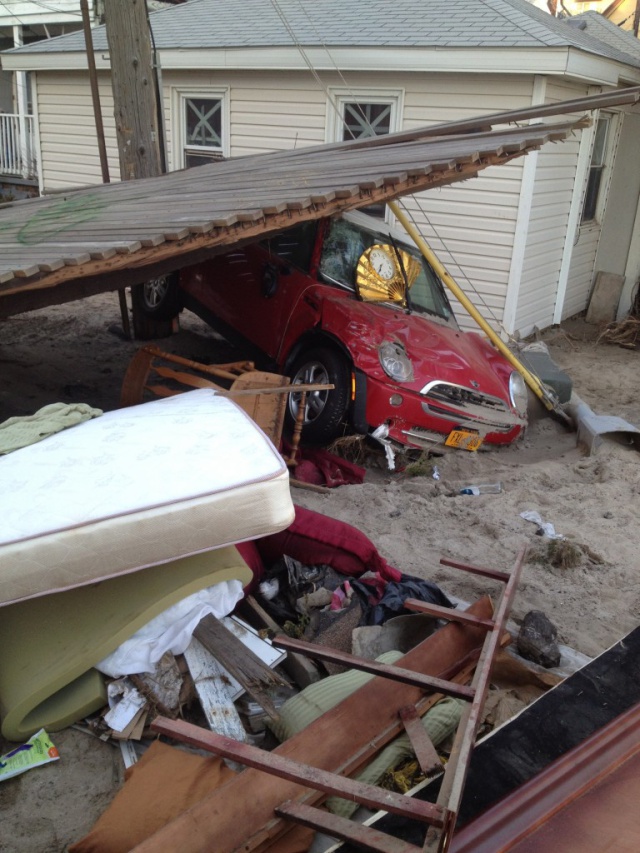
via Liz Caldas & the “Sandy Help LB” group on Facebook:
Moms & Dads! Help your kids connect with kids on the ground and still in the dark in Long Beach. Send in cards like these and they will be included in stockings….or stuff your own stockings and send to: 120 West Park Ave Suite 103 Long Beach NY 11561….no later than December 10th.
Stockings could have headlamp-flashlights, prepaid VISA or Home Depot cards, deodorant, anything else you think could help and fit in a stocking.
The following article in National Catholic Reporter touches on a conversation on climate change held at Catholic University of America. The talk brought together academics, bishops, church leaders and climate activists to explore and engage papal teaching on creation and the environment.
Fordham’s Christiana Peppard, a professor of theology who is writing a book on, Valuing Water in an Era of Globalization, is quoted in the article:
That the church sees issues of climate and the environment through “the language of fundamental rights, including the ‘right to life,’” Peppard told NCR, “is a call to awareness in our American context,” where often right-to-life talk singles out abortion.
Read the whole article here. And read about Peppard’s research here.
This excellent article by Reuters reveals “a gulf between what many people expected the [American Red Cross] to do in times of crisis and what it actually delivers.”
Key points:
Like Hurricane Katrina victims, Hurricane Sandy victims feel let down by the charity.
— The sense of letdown is all the more stark because the Red Cross, the fifth-largest charity in the United States by private donations, is viewed by many as the place to donate money when there is a major disaster at home or abroad.
— Part of the perception problem may be the massive media and advertising campaigns that the Red Cross runs when there is a disaster.
— These campaigns appear to give the impression that the charity can be all things to all victims. Many of Sandy’s victims said in interviews that this was their view before disappointment set in.
— Frustration with the Red Cross is palpable throughout the Occupy movement. “The Red Cross is useless,” said Nastaran Mohit, who runs the Occupy medical clinic in the Rockaways with volunteer doctors. “They come to me every day asking, ‘How can we help?’ “I say, ‘Send me people.’ And they tell me they’ll get back to me.”
As many of you know, my father has Parkinson’s disease. He was diagnosed in his mid-to-late 50s.
I’ll NEVER forget the look on his face when he first told me he thought he had it. By that time, I’m pretty sure he had seen a doctor. We were eating lunch at the kitchen table and he looked at me and said his arm was trembling and he thought he might have something. I was CRUSHED but, as is my style, I showed little emotion and said, “No, you’re not sick. You’re fine. Maybe you just need to rest more.”
I didn’t want to believe it and, most of all, I wanted to aleve his fears.
He looked scared. And embarrassed. And he was right. He was soon thereafter officially diagnosed.
My dad was a very active man. He always worked two jobs. He loved to ride his ten speed bike (cycled competitively in his native Colombia) and lifted weights. Slowly, his ability to do all that would leave him. Today he spends most of his time watching soccer on TV in his bedroom.
Parkinson’s is a like a slow moving physical prison. It sucks. I wish there were a cure.
Research helps. My dad had deep brain stimulation surgery about seven years ago. While it has slowed the disease, and we are grateful for that, I read up on Parkinson’s news daily, hoping there will be a breakthrough.
Eleven year old Lauren Blum of the Winchester-area in Virginia is raising money for research– not only for Parkinson’s, which her dad has, but also for multiple sclerosis, which her mom has. The feeling of having an ill parent is hard to describe. It must be harder for someone so young! This story made me smile because of her positive attitude.
Check it out:
“Half of the money I raise goes to Multiple Sclerosis and the other half goes to Parkinson’s” says Blum. She was only a baby when her parents were diagnosed with their diseases.
“I always used to worry about were they going to die and what is going to happen. You could never really know what’s going to happen with these diseases except they can’t die. When I was younger, I didn’t understand that.”
I was introduced to Kansas City rock band Making Movies during last month’s CMJ Music Marathon in NYC. They fuse Afro-Cuban rhythms with indie sensibilities to come up with bilingual songs that rock.
When they’re not working on their own music, the band is passing their knowledge onto the next generation. But it’s far more than just a guitar lesson here and there. Recently, Making Movies teamed up with the Kansas City-based nonprofit, the Mattie Rhodes Center, to put on “Musicians United by Social Influence and Cultural Awareness (M.U.S.I.C.A.)“, a camp which introduces high risk Hispanic youth from the northeast Kansas City area to the world of music.
As you’ll see in this video, they’re reaching a great group of youngsters who might not otherwise be exposed to the arts. Even better, they’re becoming young artists. The smiles on their faces as they’re playing guitar chords or belting out “La Bamba?” Priceless.
And for more information on the band, check out my Q & A with lead singer Enrique Chi in Sounds and Colours here.
If Hurricane Sandy has proven one thing, it’s that grassroots efforts can sure as hell get things done. Even better, they can work side by side with agencies such as FEMA, the American Red Cross, and even the National Guard, to help those affected by a disaster. In some cases, as you’ll see below, it seems like they’re leading!
The following Reuters Investigates video is about the Rockaway Beach Surf Club‘s well-oiled Hurricane Sandy relief machine in the Rockaways. Makes you wonder: what else could they be running?
This is what I learned this week: We are at the helm of our world community thriving or dying. Know this.
Down at Beach 23 and Seagirt Blvd in the Rockaways, the five of us, jammed in a 1990 Mazda 323, on top of 2 generators and a pump to empty basements of water, pulled up to a parking lot.
Sixty people came running to our car, surrounding it. “Do you have blankets? Please, we’re freezing!”
We had two left to give.
Read the rest of this great account of grassroots relief here.





 periMENTAL