Downloads of this album benefits three Kansas City-area charities.
A special version of “Tormenta,” by Making Movies, (available on a ’12 Days of Christmas’ album benefiting three Kansas City-area charities via the Midwest Music Foundation & Boulevard Brewing Company: http://bit.ly/1ju1hf0) is one of KCUR 89.3 FM‘s ‘Best Songs from Kansas City-area Bands in 2013.’ The song is about missing home at the holidays and was written specifically for the immigration cause.
Hear KCUR‘s other picks here –> http://bit.ly/JQx7Tn (Scroll to 38:25 to hear the special version of “Tormenta.” It is very folkloric version.)
The band is now bound for Texas. Follow the rest of their tour here, and check out this video from the last time they played the Lone Star state. (Video by the Houston-based Sinister Kid Studios.)
Life has thrown some changes my way in the past few years and the anxiety began to consume me. It started slowly, probably three or so years ago. Recently, it got worse. I became irritable and unfriendly, at first just when I was at home, then at other times. My wife has probably borne the brunt of the effects, and she’s a saint for dealing with it. I’ve tried hard not to let my children notice. I didn’t tell anyone at school how I was feeling.
Oh, what a day it’s been so far. Some of you follow me on Facebook and may recall an update about a man who Googled me on his iPad while we were on his second date, found some footage of me reporting from SXSW and proceeded to google the model/presenter who set up the segment so we can look at her in a bikini.
This inspired me to finally create a web series I had been thinking about for over a year called Bad Dates in the City, currently in pre-production! #LBDinNYCProds @BadDates
After I decided I had no interest in seeing this man again, I ignored his three texts “Did you take the bus home? “How’s it going?” and “Hello”) which came over a span of a week and a half until I opted to text him back this morning to the polite tune of, “Thanks for the other night and it was nice meeting you, but don’t wish to chat further. Thanks and good luck! Best, Lindsay”
Well, here is how this Ivy league grad with an MBA that I met on JDate responded:
Relax, this post has nothing to do with Anthony Weiner. It is an end-of-the-year roundup on wiener news, though! (And special thanks to a friend who suggested I write this.)
Before we get to it, let’s all agree that as far as 2013 is concerned, it was a monumental one in news:
The year also brought us more social media by way of Instagram and Vine videos (watch some hilarious Vine vids here), chats that disappear via Snapchat, and Twitter and Facebook continue with high engagement from their users.
On my Facebook page, it was a big (no pun intended) year for news of everyone’s favorite male member: the penis! I’ve rounded up some of the year’s best peen news nuggets below.
Best medical development for a crooked penis news: FDA approves drug for severe curvature of the penis: Treatment with Xiaflex involves two injections of the drug into the penile scar tissue and a penile “modeling” procedure that involves manipulation of the penis by a healthcare provider. It sounds painful, but so is having a crooked peen, according to the article.
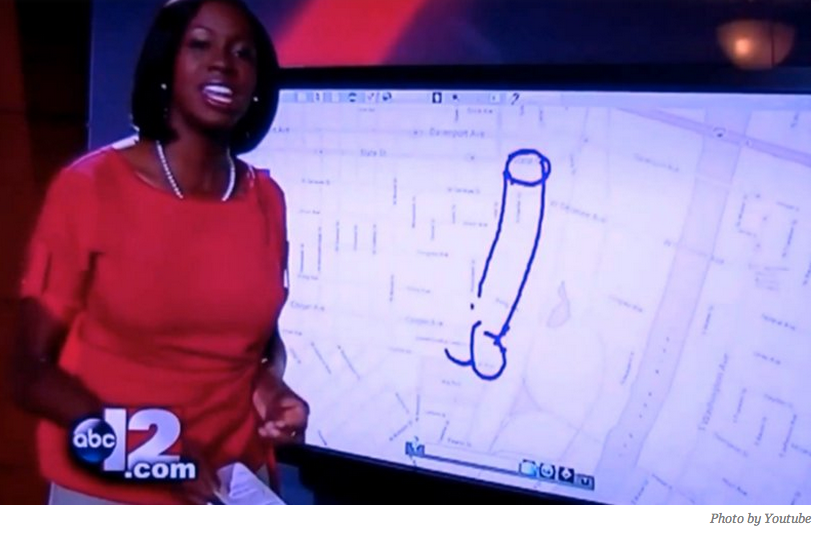
Traffic reporter Siobhan Riley says the drawing was innocent.
Best news anchor #fail related penis news (VIDEO): ABC12 news reporter Siobhan Riley was detailing which sections of Saginaw, Michigan, would be undergoing construction on a large map. As she laid out the grid plan, she unknowingly drew what appeared to be a large phallus, complete with testicles at the bottom. Hey maybe she had something on her mind.
BestMike Tyson is involved in this one, so there’s really nothing good, better, or best, about it: The former heavyweight champions autobiography contained tons of surprises about his chaotic life. In fact, that he used a Fake Penis to Pass Drug Tests is the least surprising nugget out of this gem.
Best indecent exposure arrest-related penis news:He claims his penis was itchy, but according to police, this sicko was following a customer around in a store while jerking his chicken. Gross. A Florida man arrested on indecent exposure charges said he had to expose himself in a department store because his genitals were itchy.
Best King of Pop-related penis news:The guy may be in jail, but can we all wish some collective bad juju on him in the joint for talking about this in an interview? Eww. Dr. Conrad Murray: ‘I held Michael Jackson’s penis every night’
Best science-related penis news:This may depend on your (personal issues) point of view, I guess: “The attractiveness of a larger penis is intertwined with height and body shape, new research suggests.” Penis size does matter.
Second runner-up:Oh, Florida, you know I couldn’t leave you out of this! And, to boot, you know there’s a critical shortage of good math teachers when, “Jeanne Michaud, a Seminole County math teacher, had nearly a 30-year history of disciplinary problems, but parents said she was talented and could make even advanced courses fun.” Teacher fired over penis carving.
I’ll end the list with something that sits below the peen:
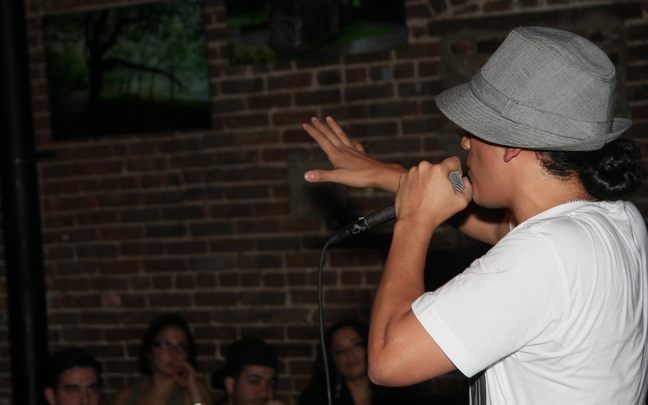
I wish I had more information to share about this video because it’s bad ass. If features a bevy of Latina rappers who I assume hail from Ecuador (they flash the flag a couple of times in the video) spitting some thoughtful lyrics about women, femininity, the barrios they are from, resistance, activism, and more.
Watch below. (And shout out to the girl who comes in at 3:53. She can spit!)
Me and spoken word don’t have much of a relationship. When it first appeared on my radar in 2002 via HBO’s Def Poetry Jam, I couldn’t watch it (I was working nights then) and somehow [wrongly] figured it wouldn’t be my thing.
A few years later, while working at a radio station in New Jersey, my boss gave me a a pair of tickets to Def Poetry Jam on Broadway. I figured, why not? I was instantly blown away. It was like rap, which I was a fan of, but at a varied tempo and performance style, and subjects ranged from life in the city to feminism.
Still, I didn’t keep up with it much. Though it was at its height then, venues hosting spoken word were few and far between when I lived in New Jersey (outside of college campuses, that is) and as a journalist working crazy hours in the middle of the Garden State, I wasn’t able to frequent New York City’s Nuyorican Poet’s Cafe. As they say, life gets in the way.
Silly me. I shouldn’t be surprised at all that the Internet is rife with spoken word videos. And it gives me great pleasure to share the latest by one of my frat brothers (yes, I was in a sorority in college), Goya Robles.
If you’re a fan of CBS’s The Mentalist, you’ll be familiar with Robles as he starred in an episode two weeks ago. He’s an actor (watch his reel here) and spoken word artist (and lots, lots more) and “Heart Music” is his latest.
My first trip ever to Europe came in late November, 2013. Destination? Spain. I loved it. Here are ten reasons why:
1) The Metro: Living in New York has made me a little bolder when it comes to doing things on my own. Trust me, just 10 years ago, I would’ve never had the guts to march into the Madrid Metro right after landing in the airport to get to my first hotel. But I did it, and it was quick, clean, safe, and easy to navigate (hint, hint, NYC). Barcelona’s Metro system was just as pleasant. Trains every three minutes, you can set your watch by it!
2) Rioja: Light, not too dry, definitely not sweet, and silky. This made from tempranillo grape wine is simply delicious, even when the bottle cost 3 euros at the supermarket. Rioja is made from grapes grown in the Autonomous Community of La Rioja, and in parts of Navarre and the Basque province of Álava. Read more here.
3) Cava: What woman doesn’t love a bubbly drink? Cava is a Spanish sparkling wine of Denominación de Origen (DO) status, most of which is produced in Catalonia. It may be white (blanco) or rosé (rosado). No more champagne for me on New Year’s Eve. I’m going cava!
4) Salvador Dalí Museum in Figueres: This museum in Dali’s hometown of Figueres in Catalonia is trippy! The heart of the museum was the building that housed the town’s theatre when Dalí was a child, and where one of the first public exhibitions of young Dalí’s art was shown. The old theater was bombed the Spanish Civil War and remained in a state of ruin for decades until Dalí and the mayor of Figueres decided to rebuild it as a museum dedicated to the town’s most famous son in 1960. My favorite piece was the “Mae West Cum Apartment.” Yes, it’s the real name of the artwork!
Mae West’s Cum Apartment by Salvador Dali.
5) Montserrat: This multi-peaked mountain located near Barcelona is one of the most breathtaking things I’ve ever seen. (Keep in mind I’ve not been to countries on the Asian or African continents). The main peaks are Sant Jeroni (1,236 m), Montgrós (1,120 m) and Miranda de les Agulles (903 m). The mountain is the namesake for the Caribbean island of Montserrat. It is well known as the site of the Benedictine abbey, Santa Maria de Montserrat, which hosts the Virgin of Montserrat (the black virgin, or la moreneta) sanctuary. “Montserrat” literally means “saw (serrated, like the common handsaw) mountain” in Catalan.
While there, I rode a funicular rack railway car up to the very top of the mountain. While it looks scary from afar, the ride couldn’t be more secure. It has six independent brake systems. If I ever go back, I’ll stay overnight for part of my stay. They have quite a few hiking trails I’d like to try.
View of Montserrat from the funicular.
6) Spanish style: My friend Doris put it best: Spanish people wear clothes that fits them. She’s right. There’s no oversized, baggy, clothes, or ill-fitting too-tight, or bummy outfits. (No sweatpants as daily wear!) The clothes they, and even their little children, wear is wear-tailored, clean, and sophisticated. Women’s hair is worn mostly long, and scarfs and sleek jackets are a mainstay. Older men dress with style. Sophisticated jackets, hats, and even glasses frames set them apart. Think Zara, perhaps the best-known Spanish retailer around the world.
7) Gaudí: Before I got to Spain, everyone told me I was going to love his work. So who was he? Antoni Gaudí i Cornet (25 June 1852 – 10 June 1926) was an architect from Reus, who was the figurehead of Catalan Modernism. Gaudí’s works reflect his highly individual and distinctive style and are largely concentrated in Barcelona, notably his magnum opus, the Sagrada Família.
The church of la Sagrada Familia is a big tourist draw and rightfully so. I’m a big fan of old churches and stained glass windows. The way the windows create an erethreal rainbow inside the church, from sacristy to nave, is a must-see. Pictures don’t do it justice, and I don’t say that often.
La Sagrada Familia by Gaudi.
8) Manchego cheese and olives: Spanish cuisine in general is great, as it feels like you’re eating “bad” (not really bad, but high in fat, though some would say it’s good fat) food all the time. They eat rich manchego cheese, sinfully delicious stuffed olives, loads of olive oil, hams, eggs, potatos (called patatas), and wine, of course! Yum. Take me back!
Suggestion: DosTrece restaurant in Barcelona is owned by an American expat. It’s got a hip, coffeehouse vibe during the day and a chic, yet casual-cool, ambience at night. (There’s also a bunch of cool images of Frida Kahlo as part of the restaurant’s decor.) The staff come from different parts of the globe and they are not only friendly, but fun, and suggest the best nightlife spots for those looking to go dancing.
DosTrece Restaurant
9) bicing in Barcelona: New York City just got a bike share program this year. It’s highly used, but not without its kinks. Also, there’s a big Citibank logo on every bike, which appears like a heavy, clunky thing to ride. In Barcelona, the bikes in the bicing bikeshare program look light, yet sturdy. They are used plentifully, day and night, as this 2009 piece in the Huffington Post explains, it has transformed the city.
But that’s not all. Spaniards in Madrid and Barcelona use scooters, motorcycles, and the tiny cars I love, such as the Toyota Yaris, the Fiat, and the Smartcar. Driving also seemed much less aggressive than New York City and many of the Latin American countries I’ve visited.
OK, so this is an older model, but tiny modes of transportation were all over this city.
10) The language: My parents hail from Barranquilla, Colombia, so I speak Spanish. But I don’t use that vosotros/vosotras “tense that your Spanish teacher told you to ignore,” as one of my travel partners put it. Well, Spaniards do. It’s Castilian Spanish, and it’s beautiful. Also, they say vale a lot. I’ll let Wikipedia explain more, but let’s just say It was hard not to fall in love with everyone who spoke it. They all sounded like Javier Bardem. Swoon.
Bronx, NY –– Nov. 13, 2013 – On Friday, Nov. 15, Deputy Bronx Borough President Aurelia Greene will join officials from the Wildlife Conservation Society’s Bronx Zoo and children from PS 205 at Zoo Center to kick-off Bronx Borough President Ruben Diaz, Jr.’s holiday toy drive to benefit Bronx military families.
In honor of the start of the holiday season, school children from PS 205 will be on hand to donate the first toys of the year.
The partnership between the Bronx Zoo and the Borough President on the toy drive has become an annual tradition. The Bronx Zoo will serve as a collection point for new, unwrapped toys donated by members of the community. Toys will be collected through the end of December and will be distributed by the Borough President’s office to local veterans and active-duty members of the military and their families.
In appreciation for their generosity, those who make a qualifying donation of a new, unwrapped toy at any of WCS’s wildlife parks between Saturday, Nov. 16 and Tuesday, Dec. 31 will receive a free ticket to the Bronx Zoo or New York Aquarium depending on location.
Toys will also be collected at the other WCS wildlife parks. Toys collected at Central Park Zoo and Queens Zoo will be donated to families in need within the communities they serve. Prospect Park Zoo and the New York Aquarium will collect toys to benefit victims of Hurricane Sandy. Toys donated at the Prospect Park Zoo and New York Aquarium will receive a ticket to the New York Aquarium. Visit http://www.wcs.org/toydrive/.
Castillo-Garsow with her mentor and co-author, Mark Naison.
If you’ve ever walked around an urban neighborhood in a major city, you may have noticed them being sold on tables set up on the streets. They are slim novels, and usually depict people in the cover art. They are urban fiction books.
Also found in bodegas, urban fiction (also known as street lit) is one of literature’s fast-growing genres.
Read my interview with Castillo-Garsow, in which she gives her thoughts on the origin of the book, but also about health and fitness (the story appeared on the Latino-centric health and wellness website, Vida Vibrante), here.
But, below, she talks to me about the characters of Pure Bronx, Khalil and Rasheeda, a young couple from the South Bronx, trying to make it out of the ghetto and have a taste of the prosperity middle class Americans take for granted.
—–
Gina Vergel: Dr. Naison mentioned (in an interview with the student newspaper, The Ram) that the story has a social justice aspect. Why did you two include such an aspect in this story?
Melissa Castillo-Garsow: Social justice for me is something that has always been a major part of my life. I originally did not like English or writing classes- the stories and main characters (mostly white male) never resonated with me and neither did classical language like that of Shakespeare. I was a good student, but I struggled a lot and didn’t enjoy reading very much. I first began to write because I proposed a column for the high school newspaper about human rights. I was a member of Amnesty International (one of two or three at my school) and was deeply concerned that people my age did know about what was happening in the world. Since then, everything I do has must have some sort of social justice aspect – I wouldn’t consider it worthy of my time, otherwise. Art for Arts sake is just not how I function. Art, writing, even academia (in the model of someone like Gloria Anzaldua) should invoke thought and emotion.
What many of the Street Lit books lacked, Dr. Naison and I found, was that aspect of social commentary. They often ended very tragically through the trope of the inevitable result of ghetto life, or overly glamorized monetary aspects of “the Life.” We wanted to provide an alternative narrative – that involvement in illegal or unsavory activities does not define you. Other possibilities are available and fulfilling, especially if you commit to social justice and your community.
GV: What can you tell me about Rasheeda’s character?
MC-G: Rasheeda is definitely a strong female character. Raised in poverty, she is committed to bettering herself through high education, even when every aspect of her life provides her with other models or tells her its not possible. She overcomes many traumatic experiences without the guidance of a father or mother while assuming responsibility for her younger brother. I loved living with Rasheeda for the years we worked on this. She is so determined, strong and confident. But she is also sassy and fun. She is the one the keeps Khalil in check.
GV: Since the story is set in the Bronx, an area teeming with Latinos these days, how much do they come into play in the story?
MC-G: Latinos are an important part of the story because they are a vital part of the Bronx. Like many African Americans, two of Rasheeda’s closest friends are Puerto Rican and there are also Mexican and Honduran characters. Khalil also understands Spanish from having grown up in projects with Puerto Ricans and other Latinos as well. At the same time we don’t glamorize relations in the Bronx – some of the African American – Latino relationships are friendship, others are antagonistic. But you will definitely find español in Pure Bronx!!
GV: You’re a doctoral student. What will your dissertation be on? What do you hope to do with your Ph.D? Teach? Any plans to continue with Street Lit?
MC-G: My dissertation is going to be on Afro-Latinos in 1920s and 1930s New York City. Afro-descended Latinos in this country are a completely understudied and diverse group in this country, especially in this time period. And yet, it was such a vibrant, artistic and important time in African American history. I want to uncover how Latinos (who because of their appearance and segregation were in very close quarters with African Americans) were relating or not relating to black culture and politics.
I do hope to teach, specifically Latino Literature and History, and perhaps some creative writing.
I also have a deep interest in popular culture – particularly Latino/a and Latin American Hip Hop. Currently, for example, I am working on a project about Mexican Hip Hop in New York. (Ed. That sounds interesting to us!)
Maybe more street lit? I’m not sure. We do have a sequel to Pure Bronx in mind. I guess it just depends on if there’s interest!
Read more about Melissa Castillo-Garsow on her website.
As Bill Keller wrote in The New York Times on Oct. 27, “Glenn Greenwald broke what is probably the year’s biggest news story, Edward Snowden’s revelations of the vast surveillance apparatus constructed by the National Security Agency (NSA). He has also been an … an advocate of a more activist, more partisan kind of journalism.”
Well, on Nov. 14, Greenwald will join a powerhouse of panelists at Fordham Law School to discuss the new revealed surveillance powers of the NSA.
Panelists, including author and NSA expert, James Bamford; playwright and professor, Ariel Dorfman; and computer security and privacy specialist, Bruce Schneier; and other distinguished guests, will discuss:
What effect is the expansive American surveillance state having on us?
Are the programs Edward Snowden revealed inhibiting the way we think, speak, and create, distorting social interactions, or damaging individuals or communities?
Join luminaries from the fields of literature, technology, media, and policy for a discussion of what we know—and don’t yet know—about how surveillance is reshaping our public and private lives.










 periMENTAL